


Introduction
Information technology (IT) is evolving due to the new discipline of quantum computing. In quantum computing, critical infrastructure serves as the foundation for applications requiring extremely secure communication and unprecedented processing capacity. The Quantum Approximate Optimisation Algorithm (QAOA) is examined and compared, and its use in locating important nodes in vital infrastructure is examined in a case study. The idealised quantum computer simulation outlines possible future solutions while exposing real-world difficulties and constraints (Silva and Droguett, 2024). The investigation of QAOA’s use in critical infrastructure analysis is consistent with developments in security protocols, including a recently suggested authentication mechanism that is secure, lightweight, and energy-efficient. Through session key formation and anonymity, this system improves user privacy while providing multi-factor authentication that is resistant to both traditional and quantum attacks. Its advantage in computing, communication, and power efficiency is further demonstrated by a security analysis, which enhances the reliable solutions required to secure quantum-driven infrastructures (Momeni et al., 2023). The practicality of integrating traditional and quantum technologies into a single network has been proved by the successful integration of quantum communication into the current telecommunications infrastructure. This development demonstrates how prepared Quantum Key Distribution (QKD) systems and contemporary networking techniques are for practical use cases and real-world deployments, as confirmed by deployment in production settings (IEEE, 2021). This research expands the use of quantum technologies to a new field with the Quantum Improved Weather Forecast framework, building on the integration of sophisticated quantum systems into practical infrastructure. The framework seeks to increase weather forecast accuracy and disaster preparedness by fusing quantum machine learning (ML) with conventional techniques, showcasing the revolutionary potential of quantum computing in a variety of domains (Suhas and Divya, 2023).
The process started with research questions intended to investigate algorithms and methods for critical infrastructure cybersecurity. Databases such as IEEE Xplore, Science Direct, and Google Scholar were used to collect pertinent data for this scoping study. A seamless and economical transition to quantum-safe cryptography is made possible by an integrated network design that blends classical and quantum communications (Aguado et al., 2019). Building on this, the study introduces a secure framework for distributing virtual network functions (VNFs) across data centres, leveraging QKD and software-defined networking (SDN) to bolster security in the evolving landscape of software-defined networks (Aguado et al., 2017a). By examining post-quantum cryptography options, this integrated approach also analyses Multimedia Internet KEYing–Sakai-Kasahara Key Encryption’s (MIKEY–SAKKE) susceptibility to quantum computing. By highlighting the trade-offs between security and performance, the study strengthens the network architecture’s resilience in the post-quantum age (Verchyk and Sepulveda, 2021). Electricity grids are vital hubs for energy supply and must be adequately protected to ensure their security. The challenges of deploying QKD systems to safeguard critical infrastructure are explored, with a real-world demonstration of their application within an electricity grid’s network (Evans et al., 2021). It is suggested that cyber-physical systems (CPS) use quantum cryptography to communicate securely, and it is investigated how quantum computing might improve these systems’ efficiency (Tosh et al., 2020). The following research questions are addressed throughout the scoping review:
RQ1: What are new quantum methods and algorithms being designed to secure critical infrastructures, and how do they compare to conventional methods?
RQ2: How are quantum computing algorithms being designed to enhance the reliability of critical infrastructures?
RQ3: What kind of quantum methods are emerging for ensuring the stability and accuracy of computations critical to manage infrastructures?
This work aims at presenting current developments in quantum computing algorithms for securing the reliable functioning of critical infrastructures. The systematic literature review of this work contributes to the understanding in how quantum computing and cyber security methods must be combined for guarding critical infrastructures. The results of this scoping review highlight the interdisciplinary nature of the field when addressing their application for safety of critical infrastructures.
The technique afforded in Section 2 is followed by our paper; the technique comprises actions such as presenting the study background, developing the research questions, and outlining the procedures for data collection, identification, screening, and paper inclusion. Section 3 presents the findings of this scoping review, systematically organised into categories and subcategories, with particular emphasis on the ways in which quantum computing threatens conventional systems. After that, the discussion is covered in Section 4, and finally Section 5 summarise all conclusions of the scoping review.
Methodology
The systematic scoping review conducted in this work aims mainly at algorithms and methods for the cybersecurity of critical infrastructures in quantum computing (QC) and details of their direct applications. The stages of the scoping review described by Arksey and O’Malley (2005) and Levac et al. (2010) were used in this study.
The study began by defining the scope of the topic and initiation of target research phrases regarding the research questions about the algorithms and methods for cybersecurity of critical infrastructures in quantum computing. IEEE Xplore, Science Direct, and Google Scholar were used and quantum critical infrastructures, quantum cybersecurity, quantum cybersecurity threats, quantum cybersecurity methods, quantum cybersecurity algorithms, quantum computing techniques, and quantum secure infrastructure analysis were shortlisted to initiate the scoping review, as described in Figure 1. The research was most relevant to the topic and it was compiled based on the results collected from different databases. In addition to this, the research was limited to journals only to obtain the most precise data. An effort was made to ensure that highly effective algorithms and methods were included in the research. Consequently, journals published from 2010 onwards were selected as the minimum timeframe for consideration. Furthermore, it was decided to limit the search to the first 420 relevant results using IEEE Xplore and first ten pages for Google Scholar.
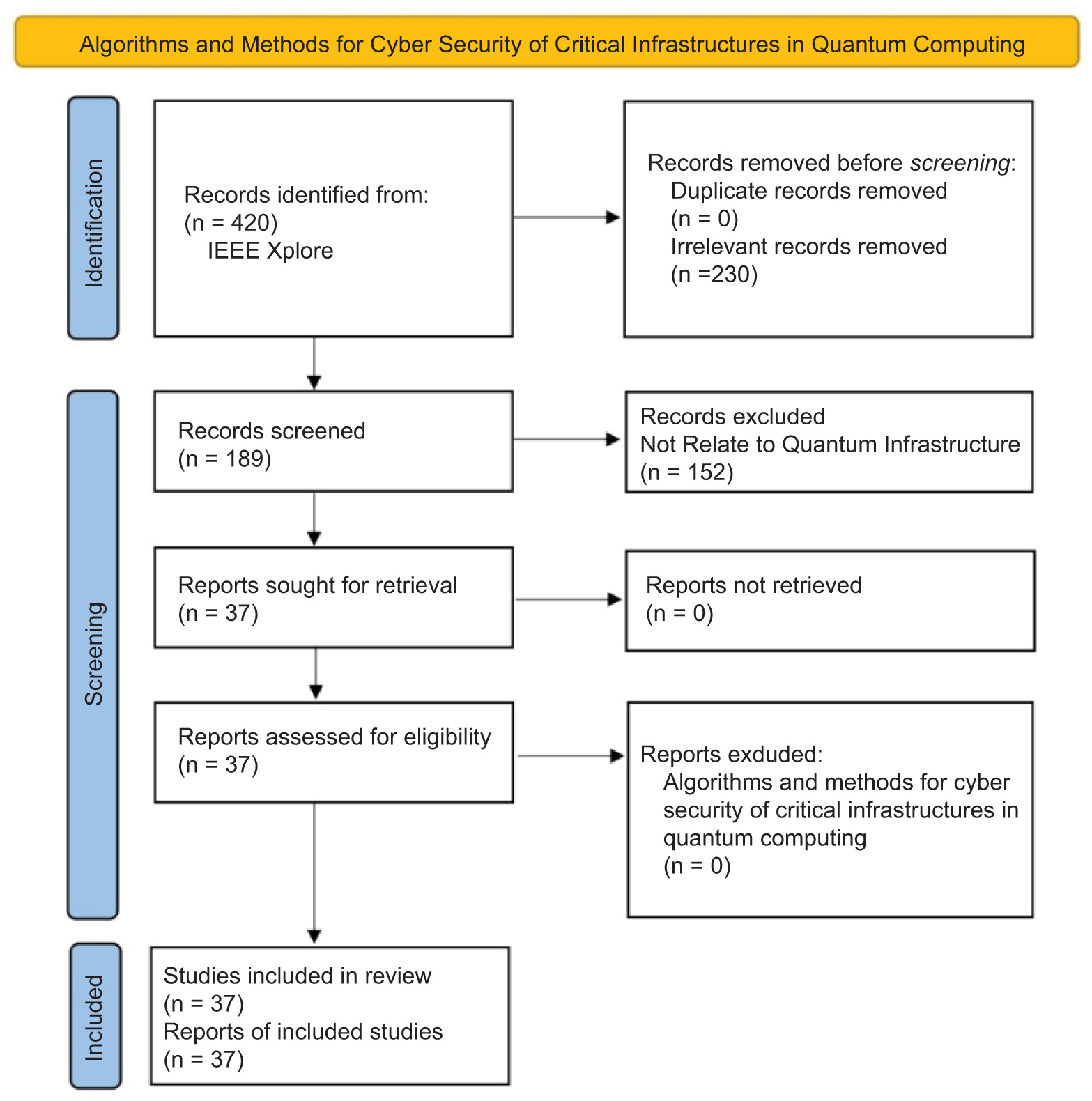
Hence, any search results with quantum studies’ irrelevant domains, for instance environmental monitoring and prediction, physics, natural disasters, etc., were easily left out using mentioned criteria. Along with these environmental and monitoring prediction and physics categories, collaboration of quantum studies was discovered with cloud computing, smart grids, system optimisation, network optimisation, cryptography, security, secure communication, networking, energy efficiency, algorithms, energy systems, protocols, distributed systems, communication, power systems, space science, and blockchain. All these are well-known domains, but research was limited and continued with optimisation, security, networking, algorithms, protocols, communication, power systems, and space science. All these categories and their references are presented in Table 1.
Table 1
Research papers
| Categories | References |
|---|---|
| Algorithms and methods | Aguado et al., 2017a, 2017b, 2019; Alam, 2017; Aleksic et al., 2013; Althobaiti and Dohler, 2021; Ansar et al., 2023; Autry et al., 2023; Evans et al., 2019, 2021; Jagan et al., 2023; Javed et al., 2024; Jenefa et al., 2023; Kebapci et al., 2022, 2023; Khan et al., 2020; Kitayama et al., 2011; Raddo et al., 2019; Rajeh, 2022; Silva and Droguett, 2024; Suhas and Divya, 2023; Tosh et al., 2020; Verchyk and Sepulveda, 2021; Yavuz et al., 2022; Zeydan et al., 2022 |
| Networking | Borah, 2023; Emu et al., 2023; Lopez et al., 2021; Kalinin and Krundyshev, 2021 |
| Protocols | Momeni et al., 2023; Niehus et al., 2023; Qu et al., 2023 |
| Application to space science, communication and power systems | Alomari and Kumar, 2023; Li et al., 2010; Liu et al., 2010 |
Results
In this review, we grouped the research papers into algorithms and methods, and applications. The applications included areas such as networking, protocols, communication, power systems, and space science. The categorisation obtained is outlined in Table 1.
Algorithms and methods
Algorithms and methods form the foundation for understanding the interplay between quantum and classical computing. By examining approaches that harness quantum mechanics besides those constrained by conventional architectures, it becomes possible to assess both advancements enabled by quantum techniques and vulnerabilities emerging within traditional systems.
Algorithms threading quantum-based systems
Recent advancements in quantum combinatorial optimisation have been reviewed with a focus on QAOA, a promising approach in the field. A case study was executed to identify the key nodes in critical infrastructure using simulated, noise-free quantum computer. The findings demonstrate that applying quantum techniques to solve combinatorial optimisation issues in real-world settings has certain practical difficulties and constraints (Silva and Droguett, 2024). Current cryptography systems are seriously threatened by quantum computing, necessitating the development of new security measures. Aguado et al. (2019) show how classical communications and QKD can be combined into a single, production-ready network. The method allows for a gradual transition to quantum-secure networks without significant disruptions or upfront costs by utilising software-defined architectures and quantum-safe algorithms. The feasibility of this approach for connecting current security with future quantum-safe systems is demonstrated by its practical application on a functioning network. Unlike conventional approaches that rely on solvable mathematical problems, QKD employs quantum mechanics to generate cryptographic keys that are secure against computing advancements. Security issues are raised by the increasing threat of adversarial attacks to generative artificial intelligence (AI) anomaly detection systems with the development of quantum computing. In order to address the shortcomings of current models, Jenefa et al. (2023) suggest a revolutionary strategy that combines sophisticated generative AI approaches with quantum-resistant algorithms. This dynamic solution increases resistance against adversarial threats based on quantum technology by adjusting to new assault techniques. A possible route to safe anomaly detection systems in the quantum era is provided by experimental results that validate their efficacy. Internet of Things (IoT) communication is made possible by narrow-band IoT (NB-IoT), but quantum computing poses threats to cybersecurity. Althobaiti and Dohler (2021) present a location-aware cryptographic system that leverages lattices for effective, portable, and quantum-resistant security, using geographic location as an identity. In contrast to current protocols, this approach ensures safe authentication, avoids location spoofing, avoids the requirement for simulation (SIM) cards and public key infrastructure (PKI), and is resistant to quantum and collusion attacks. It provides a strong solution for post-quantum IoT security and is applicable to networks other than NB-IoT. In order to assess strategies for the practical and economical deployment of quantum-encrypted communication, Aleksic et al. (2013) investigate the integration of QKD into passive optical access networks. Raddo et al. (2019) describe the creation of an open-access QKD testbed in Eindhoven (the Netherlands) with the goal of confirming technological certification, security proofs, and business applications. It aims to establish an open environment for end-to-end validation of QKD systems, in contrast to the closed QKD testbeds that are already in place. In order to improve end-user security and encourage the integration of QKD into the existing networks, the testbed investigates a quantum-to-the-home network for on-demand quantum encryption services.
Algorithms threading conventional systems
The security threats that quantum computing poses to IoT and AI-based systems, which handle private information, are addressed by Yavuz et al. (2022). The multi-party computation quantum network core (MPC-QNC) framework combines post-quantum cryptography, QKD, and AI to ensure secure, efficient, and privacy-preserving distributed systems. Key applications include trustworthy post-quantum machine learning (TPQ-ML), a secure federated learning system, and hybrid distributed quantum-safe public key infrastructure (HDQPKI), a quantum-safe PKI. VNFs across data centres also pose security challenges as networks adopt software to reduce costs. In order to enable secure and economical VNF distribution, Aguado et al. (2017a) present a secure approach that combines QKD with network functions virtualisation (NFV) and SDN. The approach demonstrates quantum communication performance in distributed settings via a time-shared optical network. QKD ensures secure communication, with numerous protocols developed to enhance utility and address channel vulnerabilities. Key QKD techniques are thoroughly examined for security in Khan et al. (2020), addressing their theoretical underpinnings, real-world uses, and simulated outcomes. Additionally, identity-based encryption (IBE) is well suited for mission-critical applications, as it uses identifiers to encrypt data without requiring user certificates or prior setup. For scalable and secure multimedia communications, MIKEY-SAKKE uses IBE; nevertheless, it also uses cryptographic techniques that are susceptible to quantum assaults. Verchyk and Sepulveda (2021) place National Institute of Standards and Technology’s (NIST) post-quantum candidates, assess MIKEY-SAKKE’s performance on limited devices, and define needs for post-quantum cryptography to replace smoothly the existing techniques. The results indicate that various combinations of post-quantum algorithms present trade-offs in speed, key size, and efficiency, as no NIST finalist fully meets all the requirements for a plug-and-play quantum-secure MIKEY-SAKKE. Implementing QKD systems for critical infrastructure also faces challenges, such as hardware interoperability, scalability, and optical loss. In order to address these concerns, Evans et al. (2021) provide findings from a field test of three QKD systems on an actual utility fibre network. For Cyber-Physical Systems (CPS) to remain highly efficient and prevent downtime, strong security is necessary. Current methods such as Advanced Encryption Standard (AES) and Rivest-Shamir-Adleman (RSA) are vulnerable to quantum computing threats. Quantum cryptography offers a robust alternative, resistant to such attacks. Tosh et al. (2020) address the effects of implementing quantum cryptography in CPS and emphasise how quantum computers can improve security by processing and communication without being constrained by scalability. Modern power grids rely on trustworthy synchrophasor measurements. The existing methods for detecting malicious data in power systems have limitations, such as failing to identify manipulated data or depending on physical device security. To ensure data provenance and prevent manipulation, Javed et al. (2024) propose a protocol based on quantum principles and physically unclonable functions (PUFs), whose effectiveness is validated through security and performance analyses using IBM’s Qiskit platform. It is lightweight, with minimal computational, communication, and storage demands, and provides strong protection against cyberattacks in the quantum era. The supervisory control and data acquisition (SCADA) systems monitor real-time data, control processes, and communicate with devices, but increasing connectivity exposes them to cyberthreats, including quantum-based attacks. To mitigate these risks, Rajeh (2022) proposes a quantum-cryptography method combining hash-based signatures and QKD for secure key generation and authentication, significantly enhancing SCADA security against quantum and conventional threats. For secure data transmission in underwater networks, Burak Kebapçı and his team presents a BB84-based real-time QKD system, integrating Field-Programmable Gate Arrays (FPGA), on-board microprocessors, and optical front-ends for photon counting. Real-time monitoring, external uninterruptible power supply (UPS), and a laser alignment tool for manual setup confirmation are included (Kebapci et al., 2022). Optical access networks offer high data proportions but pose security challenges, particularly in time-division multiplexing passive optical networks (TDM-PONs), where shared signals threaten privacy. Physical-layer encryption, such as QKD, can secure communication, while application-layer methods rely on safe key distribution. With quantum computing advancing, technologies, such as autonomous driving, require renewed security measures, and mobile networks should adopt quantum-resistant security algorithms (QRSAs) for safe connectivity. Zeydan et al. (2022) investigate how to improve data security in vehicle-to-everything services by utilising the Service & Computation Orchestrator (SCO) framework. Zeydan et al. (2022) illustrate how various computer techniques function under various central processing units’ (CPU) loads using number theory research unit (NTRU) as a quantum-resistant security algorithm (QRSA). The study also examines current standards and future directions for post-quantum security in mobile networks. As edge-based AI demands faster processing and lower latency, secure decentralised data-sharing becomes crucial. Autry et al. (2023) propose the decentralised Open IoT Security Protocol (dOISP), employing quantum-safe cryptosystems for secure communication. Networks can improve edge-based AI security and efficiency by integrating dOISP, particularly in large-scale settings (Autry et al., 2023). Kitayama et al. (2011) accepts emerging security threats in photonic networks, particularly risks to user data confidentiality and network control. Kitayama et al. (2011) propose a secure photonic network with QKD to protect control signals and user data, using generalized multiprotocol label switching (GMPLS) controllers and key management agents (KMAs) for provisioning of a secure path. A deployment roadmap addresses business- and mission-critical applications, highlighting the need for advanced cybersecurity, as traditional measures lose effectiveness. In order to improve defence cybersecurity, Ansar et al. (2023) investigate cutting-edge technologies, such as AI, machine learning, blockchain, and quantum computing. Machine learning improves accuracy, while AI can automate threat detection. Data security is guaranteed by blockchain, and although quantum computing is still in its infancy, it has the potential to both challenge and provide new encryption standards. Ansar et al. (2023) also examine how these technologies affect defence cybersecurity policy and practice. Mobile commerce (M-commerce) faces rising demands for security and privacy, especially in sensitive transactions. With merchants using Wi-Fi hotspots for online trading, secure communication is crucial. The McEliece cryptosystem, a post-quantum method, is proposed to enhance data encryption and privacy. It provides unbreakable security for mobile transactions (Alam, 2017). A real-time underwater QKD system built on the BB84 protocol and utilising FPGA technology is presented by Kebapci et al. (2023). An FPGA and an onboard computer (OBC) with optical front-ends that can count photons in real time are part of the system. For more than a 7-meter link, it was successfully tested for secure key distribution at a rate of 100 qubits per second. In addition, the system has an alignment indicator and visible laser for manual alignment checking. Computers attached to the system monitor its characteristics. Jagan et al. (2023) investigate the application of deep learning to develop a machine learning model for thwarting cyberthreats. The model uses a convolutional neural network (CNN) with variational autoencoders (VAEs) to analyse network traffic and system behaviour for threat detection. Results show high accuracy, supporting its use in automated monitoring and response. The study also enables advances in autonomous cybersecurity, global threat intelligence, and quantum-resistant encryption. SDN and NFV make networks more dynamic and cost-efficient but introduce vulnerabilities in data transfer. QKD ensures high security by generating symmetric keys resistant to cryptographic attacks. In order to secure a control layer in SDN and NFV settings, Aguado et al. (2017a) suggest integrating QKD with current protocols. It demonstrates QKD combined with conventional keys for secure SDN–cloud communication. The quantum-improved weather forecast (QWF) framework enhances prediction accuracy by integrating traditional methods with quantum machine learning. In order to improve forecasts, lower mistakes, and better prepare for extreme weather events and ultimately save lives and safeguard infrastructure, QWF uses quantum algorithms, such as quantum support vector machines (QSVM) and neural networks (Suhas and Divya, 2023).
Networking
The integration of quantum communications into current telecommunication networks is demonstrated by the Madrid Quantum Communication Infrastructure. With successful installations and use cases in manufacturing facilities, the project exhibits a high degree of technological readiness by fusing QKD systems with contemporary networking (IEEE, 2021). The proliferation of mobile devices and a wide range of apps make it difficult for network operators to effectively manage resources. By establishing several virtual networks on a single infrastructure, network slicing provides an answer. Nevertheless, network slicing optimisation is still difficult. In order to improve network slicing efficiency in self-organising networks (SONs), Borah (2023) suggests utilising quantum computing. The method enhances resource allocation by utilising quantum-inspired optimisation algorithms, such as quantum annealing and quantum evolutionary algorithms. Network slices are also modified by a quantum-assisted self-organising process in response to traffic patterns. Simulations demonstrate that this quantum-based strategy performs better than traditional techniques, providing higher service quality and efficiency. Advances in digitalisation and info telecommunications technology over the last 10 years have given cybercriminals more chances. By adapting to communication contexts, polymorphic threats are rendering conventional network defence techniques obsolete. Kalinin and Krundyshev (2021) investigate the ways in which SDN and computational intelligence (CI) can enhance network security and performance. Comprehensive protection against cyber threats is provided by methods such as machine learning, artificial neural networks (ANN), swarm intelligence, and quantum machine learning that are efficient in processing large datasets, and identifying routing anomalies, polymorphic attacks, and false data injections. By connecting both real and virtual worlds, the Metaverse improves Internet of Sense (IoS) communication and makes senses, such as taste and smell, possible. For the infrastructure that supports this, resource allocation must be done efficiently. In order to maximise resource allocation in data marketplaces, Emu et al. (2023) suggest a stochastic integer programming (SIP) model with reservation and on-demand plans. Furthermore, the model reduces computing complexity by using Quantum Neural Networks (QNN) to estimate demand with less input. The strategy is to enhance real-time management in the virtual world, boost service sales, and reduce the cost of Metaverse resources.
Protocols
Security and cloud resource issues can come up as 6G connectivity in the Internet of Vehicles (IoV) expands, resulting in more users and data. Qu et al. (2023) suggest a Quantum Efficient Privacy Protection (QEPP) protocol for private, secure edge-to-cloud transfer that makes use of quantum communication. To improve cloud performance and data processing speed, it uses an improved quantum Grover algorithm, effective coding, and quantum error correction. In addition to meeting essential requirements, such as accuracy, speed, and security, the QEPP guarantees privacy protection. Cyberattacks pose a threat to IoT, impeding its integration into vital infrastructures. In order to protect user privacy and anonymity, Momeni et al. (2023) suggest a session key establishment authentication procedure that is lightweight, safe, and energy-efficient. For increased durability, the protocol incorporates multi-factor authentication. According to a security study, it can withstand attacks from both traditional and quantum computers. Additionally, protocol performs better than current systems in terms of communication, computing, and power usage. Moreover Niehus et al. (2023) focus on the Bennett–Brassard 1984 (BB84) protocol-based QKD system, in which data is transmitted to an optical ground station from a small quantum satellite in low Earth orbit. Creating a testbed and simulator for a hardware-in-the-loop quantum photonic ground station is the goal.
Application to space science, communication, and power systems
Without requiring system changes, the advanced metering infrastructure (AMI) is intended to support future smart grid features and improve the existing smart metering capabilities. Distribution automation, service restoration, and network monitoring are just a few of the areas that gain from AMI’s improved information gathering and dissemination between consumers and utility providers. The benefits of a carefully thought-out AMI for electrical grid operations and planning are covered in Liu et al. (2010). The goal of reactive power optimisation (RPO) is to minimise power loss, manage voltage, and enhance network performance. The handling of discrete variables and non-linear functions in RPO is the subject of a recent study, with algorithm convergence being a major obstacle. In order to prevent premature convergence, Li et al. (2010) suggest an enhanced quantum discrete particle swarm optimisation (PSO) technique that combines it with chaotic optimisation. The method accelerates convergence and improves global search. Simulation results from real-world power networks and the Institute of Electrical and Electronics Engineers’ (IEEE) systems demonstrate that this approach provides significant global search capabilities and a faster proportion of convergence. Space technologies can be disrupted by space weather phenomena, such as geomagnetic storms and solar flares. Conventional detection techniques frequently lack accuracy and speed. Using quantum computing, Alomari and Kumar (2023) suggest a Hybrid Classical-Quantum Neural Network (HCQNN) that can identify space weather occurrences with 99.9% accuracy. By providing early warnings, the method lessens the effects on both economy and society while increasing the resilience of space-based systems. It demonstrates how quantum computing can enhance space weather forecasting and detection.
Discussion
The security of critical infrastructure is increasingly being shaped by quantum and post-quantum approaches. The findings suggest that algorithms, such as QAOA, post-quantum cryptographic methods, and hybrid quantum, and classical networks are moving beyond theory and are starting to offer real ways to protect systems against both current and future threats (Momeni et al., 2023; Silva and Droguett, 2024). Techniques that focus on optimisation and authentication appear especially useful for improving resilience and reliability. Communication methods, such as QKD, are already being tested in real settings, which show that gradual adoption is possible (Evans et al., 2021).
At the same time, the review points out a number of challenges. Many quantum algorithms still only exist in simulations or small test systems, and their use in large or complex infrastructures is limited by hardware and expenses (Silva and Droguett, 2024). Post-quantum cryptography is a more practical option in the short term, but open questions still exist about efficiency, scalability, and security (Momeni et al., 2023). Another issue is that most of the research looks at separate areas, such as networking, cryptography, or optimisation, without combining them into a complete model of infrastructure protection (Aguado et al., 2017b).
The results suggest that future security needs a mix of approaches. Classical defences should not be abandoned but instead combined with quantum-resistant algorithms and, where possible, quantum-based methods. Algorithms alone are not enough. Progress also depends on standards, cooperation between sectors, and investment in systems that can handle quantum communication and computation (Evans et al., 2021; Verchyk and Sepulveda, 2021).
Looking forward, research should aim to close the gap between theory and practice. Work is needed on scaling QAOA for infrastructure optimisation, creating efficient hybrid communication protocols, and designing adaptive systems that use both AI and quantum-resistant methods (Momeni et al., 2023; Silva and Droguett, 2024). It is also important to study non-technical factors, such as regulations, standards for interoperability, and policies for risk management, so that new algorithms can be applied in practice (Aguado et al., 2019).
Quantum algorithms and methods have the potential to change how we protect critical infrastructures, but this role is still developing. The field carries a lot of promises but also many uncertainties. Interdisciplinary research and practical demonstrations are essential to make sure that the benefits of quantum computing are achieved without creating new risks for vital systems (Evans et al., 2021).
Conclusions
In order to address our research questions, we investigated how new quantum techniques and algorithms are being developed to safeguard critical infrastructure and how they stack up against traditional approaches (RQ1). Because of the development of cyber techniques and the potential for exploitation of the security of critical infrastructures in quantum computing, this issue is crucial for research right now. There ought to be a few potential solutions to get around these weaknesses. We therefore inquired as to how quantum computing algorithms are being developed to improve the dependability of vital infrastructures (RQ2) and what quantum techniques are developing to guarantee the accuracy and stability of calculations that are essential for infrastructure management (RQ3). In the cyber world, modern systems share information with each other and are becoming more interdependent. This data is essential to infrastructure operations, but there is a chance that it could be hacked. By using different algorithms and techniques to secure vital infrastructure in quantum computing, this risk can be reduced. Recent advancements in quantum combinatorial optimisation, using the QAOA, highlight challenges and limitations in applying quantum methods to real-world problems, as observed in a case study on critical infrastructure. The MPC-QNC architecture, which integrates post-quantum cryptography, QKD, and AI, was presented to ensure distributed systems that are secure, efficient, and protect privacy. Another approach uses software-defined architectures and quantum-safe algorithms to enable a gradual shift to quantum-secure networks without major disruptions or upfront expenses. The study proposes a novel approach that blends quantum-resistant algorithms with advanced generative AI techniques. By adapting to novel attack strategies, this dynamic approach strengthens defences against adversarial threats based on quantum technologies. Optimising network slicing is a challenging procedure. The use of quantum computing has been explored as a means of increasing network slicing efficiency in SONs. With the use of quantum-inspired optimisation methods, including quantum annealing and quantum evolutionary algorithms, the technique improves resource allocation. This study is not exhaustive. Numerous secure quantum authentication methods, scalable quantum security solutions, robust quantum infrastructure, etc. are the subjects of future investigations.