

Introduction
Russia’s full-scale invasion of Ukraine has become the most consequential test case for prevailing assumptions about military transformation in a generation. Drones, persistent surveillance, and precision strikes are frequently presented as evidence that contemporary battlefields are undergoing a fundamental transformation. Policy analysis and military commentary tend to privilege visibility and speed, presenting contemporary combat as a decisive break from earlier forms of warfare.
Empirical patterns from the conflict complicate this interpretation. Despite unprecedented levels of battlefield observation and the rapid spread of unmanned systems, the conflict has repeatedly settled into positional patterns of fighting, with forces relying on fortified terrain, sustained indirect fire, and the preservation of combat power, rather than offensive manoeuvre (Gressel, 2024; Watling and Reynolds, 2023). Artillery continues to account for the majority of battlefield lethality, whereas manoeuvre operations have tended to be expensive and difficult to sustain over time (Kofman and Gady, 2023; Watling and Reynolds, 2025).
Operational outcomes remain strongly shaped by factors such as terrain, weather conditions, logistical capacity, and force density. Advances in sensing and targeting technologies have altered how these constraints manifest themselves, but they have not removed their influence (Biddle, 2004; Kofman and Gady, 2023). The persistence of fortified positions, high ammunition expenditure, and prolonged attrition positions uneasily with accounts that frame technological innovation as inherently transformative.
Battlefield transparency, as used in this article, refers to the persistent and often near-real-time visibility of force positions, movements, and losses. In the Ukrainian war this visibility results from the combined use of drone-based intelligence, surveillance, and reconnaissance (ISR), commercial satellite imagery, and open-source reporting. In much contemporary commentary, this level of observation is often assumed to translate directly into operational advantage. This assumption does not hold. Transparency does not translate automatically into control. The availability of data does not ensure the capacity to process, integrate, and act upon it under combat conditions. In Ukraine, the speed at which information is generated has frequently exceeded institutional and organisational capacity to exploit it. Open-source intelligence, battlefield sensors, and captured materiel have produced vast quantities of data, but in practice, the translation of information into timely adaptation has often been constrained by logistical bottlenecks, organisational fragmentation, and the cognitive strain experienced by units operating under sustained fire (Hvizda et al., 2025; Rietveld, 2025). A further weakness lies in technical exploitation (TE), the ability to process and use captured enemy materiel and technical intelligence. As Rietveld (2025, p. 457) shows, this function remains a structural bottleneck, limiting the speed and depth of adaptation across North Atlantic Treaty Organization (NATO) forces, a point returned to in the “Discussion” section.
These dynamics are not unique to the digital era. War has long been shaped by constraints that resist technological solution. Geography, climate, human endurance, and organisational friction have conditioned military action across centuries. As Clausewitz (1989) observed, war cannot be reduced to any single dimension of calculation or technique, it unfolds through the interaction of material limits, uncertainty, and human judgement. What changes with technological development is not the disappearance of these constraints but the circumstances under which they become visible and decisive. In Ukraine, river crossings, seasonal mud, urban destruction, and the exhaustion of units rotated through months of continuous contact have repeatedly reasserted limits on what forces can do, regardless of the sophistication of their sensors or weapons. Critical work on military transformation cautions against treating technological change as inherently decisive, a caution that the Ukrainian case confirms and complicates.
Technological change is clearly present in Ukraine, but its effects appear selective rather than uniformly transformative. New capabilities have altered the tempo and cost structure of combat without removing the enduring influence of terrain, logistics, attrition, and organisational limits. Under conditions of persistent observation and sustained firepower, some forms of force employment remain viable, while others become prohibitively expensive. Rather than expanding operational choice, the conflict has often narrowed it.
The Russia–Ukraine war is examined here precisely because it combines extensive technological innovation with prolonged, high-intensity combat. It offers sustained empirical material on how new capabilities interact with environmental, logistical, and organisational limits over time. The conflict is not treated as a clean illustration of doctrinal rupture but as a setting in which adaptation unfolds unevenly under pressure.
This article asks why similar operational constraints continue to emerge across different technological domains and successive phases of the Russia–Ukraine war despite ongoing innovation, and through what mechanisms these patterns persist. Its purpose is to develop the battlefield filtering model as a theoretically grounded explanation for this recurrence.
The article does not seek to provide a comprehensive operational history of the conflict. Instead, it focuses on explaining a phenomenon that the existing frameworks frequently identify but do not fully account for. The argument unfolds in four stages. The next section explores how heightened battlefield transparency interacts with physical, logistical, and organisational constraints. The following section examines positional adaptation as a rational response to these pressures. The “Findings” section brings the empirical material together through the battlefield filtering model, while the “Discussion” section situates the framework within the broader literature on military transformation and organisational adaptation.
Institutional analyses (Gressel, 2024; Hvizda et al., 2025; Watling and Reynolds, 2023, 2025) document patterns of tactical adaptation and sustained attrition with considerable empirical detail. Watling and Reynolds (2025), for instance, demonstrate that artillery continues to account for the majority of battlefield lethality and that manoeuvre corridors have narrowed progressively. Yet these studies stop short of explaining why similar operational patterns recur across domains with very different technological profiles from drones to armoured systems and precision strike and across successive phases of the war.
Interpretation therefore continues to draw on concepts shaped by debates surrounding the Revolution in Military Affairs (RMA). Sharman (2018) demonstrated the persistent gap between claims of technological transformation and the empirical record of war. Biddle (2004), writing in a different technological context, located the viability of manoeuvre in the interaction of terrain, force employment, and combined-arms integration rather than in technological generation alone. A comparable insight appears in research on emerging technologies. Even before the full-scale invasion of Ukraine, studies of drone warfare suggested that the operational consequences of new systems depend less on the technology itself than on how it is integrated into doctrine, organisational structures, and patterns of force employment (Calcara et al., 2021).
This argument has earlier roots. Mearsheimer (1983) showed that the prospects for offensive breakthrough depend primarily on force-to-space ratios and the depth of defensive positions. Where defenders maintain sufficient density and operational depth to prevent rapid penetration, attackers are pushed towards either expensive attritional warfare or limited objectives that abandon the prospect of decisive victory. Although his framework was developed in the context of a potential NATO-Warsaw Pact conflict and does not address persistent surveillance or unmanned systems, it established an important point: shifts from mobile to positional warfare emerge from structural features of the operational environment rather than from a lack of operational ambition. The filtering model extends this logic to conditions of cumulative attrition that Mearsheimer (1983) did not examine.
These frameworks capture much of the logic of force employment, but they were developed before the capability environment now visible in Ukraine. There the battlefield is shaped by persistent drone surveillance, extensive electronic warfare, and large volumes of commercially available open source intelligence (OSINT) circulating under conditions of near-continuous observation. Biddle’s (2004) framework, nevertheless, remains useful because it places technological change within the interaction of terrain, force employment, and organisational practice. It clarifies which factors shape operational outcomes at a given moment. What it does not address is how those options gradually narrow as attrition accumulates, adversaries adapt, and industrial limits begin to matter. Work on military innovation highlights a related issue. Adamsky’s (2010) comparative study of the reception of the information technology revolution in military affairs (IT-RMA) in Russia, the United States, and Israel shows that strategic culture, institutional structures, and cognitive styles mediate between technological availability and operational effect. At the organisational level, Hunzeker and Harkness (2021) argue that institutionalised feedback loops, rather than doctrine or equipment alone, allow armies to recognise failure and circulate lessons while operations are ongoing. Together, these studies demonstrate that organisational capacity strongly influences whether technological change translates into battlefield effectiveness. What remains less clear is how that capacity interacts with physical and material constraints under conditions of sustained attrition and how the combination of these pressures gradually reduces the range of viable force employment options. The Ukrainian case brings this dynamic into sharp relief.
Work published since 2022 increasingly uses Ukraine to reassess assumptions about future war. Sweijs and Michaels (2024) assemble a wide range of perspectives from strategic studies. The volume demonstrates that transformation predictions have not held up in Ukraine. It is less explicit about the causal chain linking operational conditions to those outcomes.
Berthelsen (2026) points to the persistence of the war–peace binary as a structural weakness in innovation theory. The argument stops short of tracing how capabilities are selected or sidelined under sustained operational pressure. These studies reinforce the critique of transformation theory, yet they rarely specify the causal mechanism behind the patterns they identify. Much of this literature documents empirical trends with considerable precision, but the causal pathway linking operational conditions to observed outcomes remains underspecified.
A recurring issue concerns the way capability performance is evaluated. Many analyses assess military effectiveness at a particular moment rather than examining how the range of viable operational options gradually contracts as attrition accumulates and adversaries adapt. Biddle’s (2004) account of force employment is analytically powerful in identifying the conditions under which certain practices remain effective. At the same time, it largely treats those conditions as imparted and therefore leaves open the question of how they erode under sustained operational pressure.
A related limitation appears in the literature on organisational adaptation. Studies such as Hunzeker and Harkness (2021), Adamsky (2010), and Ryan (2024) show convincingly how military organisations learn and adjust in wartime. What they explore less systematically is the interaction between that adaptive capacity and the material constraints that define the boundaries of the operational environment. Recent institutional analyses of the war in Ukraine provide another important body of evidence. These reports offer detailed empirical accounts of battlefield developments, yet they remain primarily descriptive. They show what has occurred across domains, such as drone warfare, armoured manoeuvre, and urban combat, but they are less explicit about why similar constraints repeatedly emerge across these different forms of fighting and successive phases of a prolonged conflict. The present study addresses this explanatory gap. It asks why comparable operational constraints continue to appear across technological domains and phases of the Russia– Ukraine war despite substantial technological innovation, and proposes a theoretically specified mechanism, the battlefield filtering model, to account for this pattern.
The filtering model departs from the existing frameworks in several important respects. Most notably, it introduces a temporal dimension that is largely absent from Biddle’s (2004) account of the modern system of force employment. Whereas Biddle identifies the conditions under which particular forms of force employment remain viable at a given moment, the filtering model examines how those options gradually contract over time as attrition accumulates, adversaries adapt, and industrial limits begin to shape what can be sustained in practice. The model also diverges from transformation theory and the literature on RMA in its basic explanatory focus. Rather than asking which technologies prevail on the battlefield, it examines the conditions under which any capability regardless of its technological sophistication remains operationally usable once sustained pressure, disruption, and loss are taken into account. A further difference concerns the relationship to recent institutional assessments of the Ukraine war. These studies document patterns of adaptation and operational change with considerable empirical precision. The filtering model addresses a different question: It seeks to specify the mechanism through which such patterns emerge, explaining why similar constraints repeatedly shape outcomes across domains and phases of the conflict.
Table 1 summarises the principal differences between the filtering model and the two frameworks with which it engages most directly. The category of RMA and transformation theory necessarily condenses a heterogeneous body of scholarship. Although Horowitz and Rosen (2005) and Krepinevich (1994) approach military innovation from markedly different analytical perspectives, Sharman (2018) arrives at a similar implication in his study of early modern European expansion, demonstrating that claims of military- technological superiority have often extended beyond what battlefield outcomes themselves appear to justify.
Table 1
The battlefield filtering model in relation to the existing frameworks.
| Biddle (2004) | Mainstream RMA/transformation theory | Battlefield filtering model | |
|---|---|---|---|
| Unit of analysis | Force employment practices at a given moment | Technology as the primary independent variable | Interaction of operational constraints over time |
| Temporal dimension | Primarily static at the operational level: conditions shaping force employment are treated as relatively fixed within specific operational contexts. | Linear: new technologies diffuse and displace older practices. | Dynamic: conditions erode cumulatively under sustained pressure. |
| Core question | Which forms of force employment succeed under which conditions? | Which technologies prevail as they diffuse across militaries? | Which capabilities remain usable as operational conditions deteriorate? |
| Explanatory mechanism | Modern system of force employment: terrain, combined arms, dispersion | Technological superiority and diffusion rates | Environmental selection under sustained attrition. Capabilities persist only if they function within interacting physical, logistical, organisational, and adversarial constraints. |
| Directional expectation | Conditions that make practices effective are specified at a given moment: the framework does not address how those conditions change under sustained operational pressure. | A significant strand of RMA scholarship anticipated that diffusing precision-strike and information technologies would compress decision cycles and enable renewed operational manoeuvre: expectations that the Ukraine war has only partially validated. | As operational intensity increases and sustains, the range of viable force employment options should narrow. The pace of narrowing is expected to vary with industrial depth and organisational learning capacity. Variables in the Ukrainian case illustrate but do not systematically test across conflicts. |
| Relation to Ukraine | Clarifies which factors shape force employment outcomes at specific operational moments. | Anticipated compressed timelines and restored manoeuvre: conditions Ukraine has produced only partially and unevenly. | Explains why similar constraints recur across domains and successive phases of the conflict. |
The sections that follow apply this framework to the empirical record of the conflict, tracing how each of the four filters manifests across successive phases of the war. The battlefield filtering model developed in this article describes the causal process through which interacting operational constraints gradually reduce the range of force employment options that remain viable in prolonged combat. The argument rests on four types of constraints that shape battlefield outcomes.
The first set of pressures derives from the physical environment. Terrain, weather, and the degree to which the battlespace can be observed by sensor systems influence whether particular capabilities can be employed effectively. The second set of pressures concerns sustainment: the availability of ammunition, the resilience of logistics networks, and the industrial capacity required to replace losses over time. Van Creveld’s (1977) historical analysis of European warfare showed that logistical capacity has long shaped not only what commanders could attempt but also how long operations could be sustained, regardless of tactical skill or weapon quality. Within the filtering model, sustainment is therefore treated not as a background condition that establishes an initial ceiling and then fades from view but as a continuing source of pressure that becomes more restrictive as conflict endures. The third factor lies in organisational learning, understood here as the ability of military institutions to absorb battlefield experience, shorten feedback cycles, and adjust practice while operations are ongoing. Finally, adversarial adaptation plays a central role. Opponents respond to new capabilities through countermeasures, tactical adjustments, and doctrinal changes that gradually undermine the conditions on which those capabilities depend. These pressures rarely operate independently. Their effects accumulate and often reinforce one another. A capability that can withstand a single form of constraint may lose its operational relevance once several pressures converge. What matters, therefore, is not simply whether a capability works under favourable conditions but whether it remains usable as those conditions deteriorate.
The filtering model rests on a distinction that requires clarification. Filtering is analytically different from the Clausewitzian concept of friction present in all armed conflicts. The distinction concerns the way constraints develop and the way they affect military capabilities. Filtering is cumulative rather than episodic. The constraints it describes do not disappear after individual engagements but intensify over time, gradually narrowing the range of viable options for force employment. Friction, by contrast, is a persistent condition of military operations. It affects all forms of combat, but it does not necessarily build up in ways that change what remains operationally possible on the battlefield. Filtering works differently because its effects accumulate over time. Capabilities exposed to filtering do not disappear entirely; rather, the range of situations in which they can be used effectively becomes progressively narrower. The issue is not whether a system continues to exist, but whether it can still be employed at acceptable cost. As combat continues, the conditions that once enabled broader use gradually deteriorate, including the readability of terrain, the reliability of logistics, organ-isational cohesion, and the adversary’s lack of familiarity with emerging methods of attack.
The model does not identify a fixed threshold at which filtering begins to produce observable effects. Its emergence depends on the interaction between operational intensity, the pace of adversarial adaptation, and the resilience of sustaining infrastructure, all of which vary across conflicts. What the model does suggest is a directional relationship: as sustained combat continues, the range of viable options for force employment tends to contract rather than expand. This contraction becomes more pronounced when several filters operate at the same time. The four filters are analytically distinct but operationally interconnected. The physical environment shapes the sustainment corridors that remain viable. Sustainment capacity affects whether organisational learning can be supported over time. Organisational learning, in turn, influences how effectively adversarial adaptation is identified and countered. Any single filter may be sufficient to sideline a capability, but the most consequential narrowing occurs when multiple constraints converge simultaneously. It is this interaction, rather than the presence of any individual constraint in isolation, that constitutes the central mechanism of the filtering model.
The model also generates a falsifiable expectation. Conflicts marked by high operational intensity, limited industrial replacement capacity, and weak organisational learning mechanisms should experience a faster and more pronounced contraction in viable force employment options than conflicts where these pressures are less severe. Cases in which forces retain a broad operational repertoire despite prolonged high-intensity combat would place important limits on the model’s explanatory reach and require its underlying assumptions to be revised or qualified.
The model is consequently temporal in orientation. Rather than asking which capabilities are effective at a particular moment the question that structures much of the existing literature on force employment, it asks which capabilities remain viable as attrition mounts and the operational environment changes. In this respect it differs from Biddle’s (2004) framework, which specifies the conditions under which manoeuvre can succeed but does not follow how those conditions erode over time. It also departs from transformation theory, which concentrates on identifying which technologies prevail, while paying less attention to the environmental and organisational constraints that determine whether any technology can be sustained in practice.
The model specifies a causal logic through which the operational environment effectively selects which capabilities endure sustained pressure. A capability persists only if it can function within interacting material and organisational constraints—physical environment, sustainment capacity, organisational learning, and adversarial adaptation. The model does not seek to provide a descriptive taxonomy of the capabilities that survived in Ukraine. Instead, it introduces a theoretically specified mechanism designed to explain how capabilities are selected under conditions of cumulative attrition. The distinction is important: whereas transformation theory focuses on identifying which technologies prevail, the filtering model examines which combinations of capability and environment remain workable as operational conditions deteriorate.
The framework builds on Biddle’s (2004) account of terrain, force employment, and combined-arms integration as determinants of operational viability. It also extends that perspective to pressures now clearly visible in Ukraine, persistent surveillance, large-scale electronic warfare, and prolonged industrial attrition—developments that the original framework did not fully anticipate.
The study adopts Critical Interpretive Synthesis (CIS) (Dixon-Woods et al., 2006, p. 5) because the explanatory problem cuts across diverse disciplinary traditions and forms of evidence. Systematic review methods require broadly comparable studies, conditions not met in the present case, while process tracing depends on evidentiary granularity unavailable in open-source institutional assessments alone. CIS is therefore better suited to integrating heterogeneous sources while allowing the construction of a theoretically coherent explanatory argument rather than the testing of a pre-specified hypothesis.
The corpus combines institutional battlefield assessments published between 2022 and 2025 with peer-reviewed scholarship on military transformation and organisational adaptation, alongside selected works of military history relevant to the filtering mechanism examined here. Sources were included where they clarified the relationship between operational conditions and capability performance and excluded where they addressed analytically peripheral questions.
The analysis proceeded through four interconnected stages. First, patterns in capability performance were identified across phases of the conflict and operational domains, particularly where outcomes diverged from the expectations of transformation theory. The operational conditions surrounding these patterns were then examined to identify constraints repeatedly associated with declining capability relevance. Institutional assessments, peer-reviewed scholarship, and historical analogies were subsequently interpreted comparatively to clarify the causal relationship between operational conditions and battlefield outcomes. From these recurring interactions, the battlefield filtering model emerged inductively rather than through the application of a predetermined framework. These stages did not unfold in a rigid sequence. Insights generated at later points in the analysis frequently required returning to earlier material while the model itself was progressively refined as new sources were incorporated and emerging patterns assessed against a broader body of evidence. Several procedural decisions shaped how evidence was handled. Patterns were treated as analytically significant when they appeared across different capability domains, including drones, armoured systems, and indirect fire, and across successive phases of the conflict. Their recurrence in varied operational contexts suggested broader structural features of the battlefield environment rather than isolated domain-specific dynamics. Where sources conflicted, the disagreement itself was treated as analytically informative instead of being resolved in favour of a single interpretation. In several cases, such tensions pointed to the interaction of multiple filters operating simultaneously. The transition from observed patterns to the filtering mechanism followed an abductive logic. The four filters were not derived deductively from prior theory or induced mechanically from the evidence, but emerged as the most parsimonious explanation consistent with the patterns identified across sources. Each filter corresponds to a form of constraint repeatedly associated with declining capability relevance across domains and phases. In principle, the removal of such constraints would be expected to produce different operational outcomes.
The final corpus consisted of thirty-six sources: nineteen peer-reviewed journal articles, eight institutional and policy reports, five monographs, one each of edited volume, working paper, and practitioner analysis, assembled around three considerations: temporal scope, institutional access, and theoretical relevance. The review focuses on the period from 2022 to 2025. Assessments produced by the Royal United Services Institute (RUSI), RAND Corporation, the European Council on Foreign Relations (ECFR), the European Union Agency for Cybersecurity (ENISA), and the Finnish National Defence University (NDU, Helsinki) formed the primary empirical basis because they provided longitudinal analysis of battlefield adaptation across successive phases of the conflict. Beside these, the study draws on scholarship of military transformation, organisational adaptation, and RMA to provide conceptual framework through which the empirical material is interpreted.
A limited reference to developments in the northern Gaza Strip (2023–2025) is included to examine whether the precision-degradation dynamic identified in Ukraine also appears under different political and environmental conditions. This comparison is intended as a targeted analytical extension rather than as a fully developed parallel case study.
High-transparency warfare and enduring constraint
The cases discussed in this section show how the four filters outlined in the battlefield filtering model manifest themselves in operational practice. Different domains, such as terrain, sustainment conditions, the electromagnetic environment, and organisational capacity, shape the circumstances in which particular capabilities remain usable. Increased battlefield transparency does not eliminate these constraints. Instead, it tends to shorten the time between the emergence of a mismatch and its operational consequences, making the costs of misalignment between capabilities and the conditions of their employment visible more quickly.
The war in Ukraine has unfolded under conditions of persistent, near-real-time visibility of force positions, movements, and losses. Drone ISR, commercial satellite imagery, and open-source reporting have combined to produce a level of exposure that differs in kind from earlier patterns of battlefield observation. Information now circulates across wide areas with minimal delay and is no longer confined to state-controlled channels. Jójárt (2024) notes that this problem has not escaped Russian planners; contemporary doctrine reflects attempts to grapple with the realities of a “transparent battlefield.” Efforts to restore operational mobility through dispersion, extensive electronic warfare, and tactical innovation illustrate this adjustment. Yet doctrinal modification alone has not mitigated the structural constraint imposed by persistent exposure. The limitation appears less conceptual than environmental in nature. In practice, transparency has changed the character of uncertainty rather than eliminating it. Open-source intelligence illustrates this tension clearly. At the tactical level, OSINT can complicate command cycles by overwhelming units with partial or misleading data, while at the strategic level, it shapes political narratives, debates over arms deliveries, and public perceptions of the war. As Domalewska (2021, p. 21) notes, disinformation campaigns are designed precisely to generate confusion and complicate decision-making beyond the battlefield itself. At the same time, systematic visual documentation of equipment losses has informed Western assessments of attrition and sustainment requirements. Research on military geoscience and geospatial intelligence similarly suggests that the growing reliance on real-time geo-spatial data and OSINT increasingly strains institutional capacity for verification and timely analysis under conditions of high operational tempo (Henrico, 2025).
Persistent observation has increased the penalties associated with poor terrain use without altering the underlying geometry of movement. Forces advancing along fixed axes road-bound approaches, river crossings, or narrow urban corridors remain constrained by geography regardless of whether detection is avoidable or assumed. Along the Dnipro crossings attempted during the autumn offensives of 2022–2023 and in the Donbas road network, exposure translated quickly into fire, but the basic problem was not visibility itself (Watling and Reynolds, 2023). Political and legal limits further shaped the operational value of precision capabilities. The seizure of the Zaporizhzhia Nuclear Power Plant illustrated how certain spaces function as de facto sanctuaries. High-resolution sensing made activity visible, but the risk of environmental catastrophe and legal escalation constrained the use of precision fires (Przybylak, 2024, p. 94). Such facilities function as “nuclear shields” where the presence of occupying forces creates a protected zone that sensors can observe but precision weapons cannot strike without violating international humanitarian law. In such cases, transparency produced knowledge without freedom of action.
Terrain compounded these effects unevenly. In forested and semi-urban belts, restricted lines of sight and limited mobility reduced the practical benefits of persistent surveil-lance. Observation increased the penalty of movement without opening any new avenues for it. Dispersion, fortification, and reduced tempo became the least expensive responses to constant exposure. Urban destruction produced a related constraint. As cities such as Bakhmut (contested from mid-2022 through May 2023) and Marinka (under sustained assault throughout 2023) were reduced to rubble, the physical environment became less legible to sensor systems calibrated for intact structures (Gressel, 2024; Watling and Reynolds, 2023). Collapsed buildings disrupted line-of-sight targeting, obscured thermal signatures, and created subsurface movement corridors that overhead ISR struggled to track. A similar dynamic could be observed in the northern Gaza Strip (2023–2025). The two cases differ substantially in scale, political context, and force composition. The comparison rests on a narrower point. In both cases, the progressive destruction of urban structures reduced the legibility of terrain for sensor-based targeting, shifted combat towards suppressive area fires, and degraded the environmental conditions required for discriminate precision employment. It is the recurrence of this precision-degradation dynamic, rather than any broader equivalence between the conflicts, that the comparison is intended to highlight. As urban structures collapse, they generate subterranean movement corridors and disrupt line-of-sight geometry, complicating sensor-based targeting and favouring suppressive fires (Benguita, 2025; Phocas, 2024). The appearance of this pattern in two operational environments with otherwise distinct characteristics suggests that the influence of the physical environment operates with a degree of independence from the specific context of a conflict. Prolonged high-intensity combat tends to erode the environmental conditions on which the effective employment of precision systems depends. Environmental factors imposed additional limits. Weather conditions, such as fog, precipitation, and seasonal mud, regularly degraded drone operations and strike correction. During such periods, forces fell back on unguided artillery and pre-registered fires a practical accommodation to degraded sensing, not a doctrinal choice.
Logistics proved considerably less adaptable. Precision systems relied on continuous flow of ammunition, spare parts, energy, and transport capacity to remain operational. Disruptions affecting rail nodes, depots, or supply corridors therefore shifted attention towards sustainment constraints rather than detection capabilities. Urban combat is estimated to consume four times more ammunition and two-and-a-half times more rations and water than comparable rural operations, significantly increasing the burden on sustainment systems (Phocas, 2024).
These pressures are further intensified by the vulnerability of military transport networks to cyber disruption. Across the transport sector, distributed denial-of-service (DDoS) attacks increased by 53% and ransomware incidents by 19% between 2022 and 2023, with military logistics nodes increasingly identified as priority targets (Constantinescu, 2025; Theocharidou, 2023). Operational tempo was consequently shaped more by ammunition expenditure and replacement capacity at industrial scale than by access to technologically advanced platforms.
The electromagnetic environment narrowed options in a different way. Electronic warfare disrupted unmanned systems unevenly, forcing operators to shorten engagement ranges or accept higher loss rates. Adaptation followed pragmatic paths: frequency hopping, redundancy, and acceptance of attrition over technological escalation. These measures were often implemented at unit or workshop level. At the same time, experiments with large-scale, synchronised unmanned aerial vehicle (UAV) strikes, such as those described by Henrico (2025), demonstrate that even highly automated engagement remains dependent on favourable environmental, logistical, and organisational conditions, limiting its generalisability across the front.
Across these domains, automation left the human element intact. Operators remained responsible for interpreting degraded sensor feeds, maintaining equipment under fire, and deciding when losses became unacceptable. Research on Ukrainian frontline units documents that prolonged deployment, sleep deprivation, and continuous exposure generate cumulative psychological stress that degrades decision-making capacity over time (Hukovskyy et al., 2024). Training quality, unit cohesion, and organisational tolerance for attrition proved more consistently decisive than access to technology.
High battlefield transparency does not remove these constraints. Its principal effect is to accelerate the rate at which they operate, increasing the penalties when capabilities are misaligned with the conditions in which they are employed.
Beyond the breakthrough: positional adaptation and the logic of heavy forces
Predictions of manoeuvre-centric, technology-driven warfare have circulated for decades. Krepinevich (1994) argued that precision strike and information dominance would fundamentally alter the character of land warfare, enabling rapid and decisive operations that bypass attritional dynamics. Horowitz and Rosen (2005) identified the diffusion of such technologies as the primary driver of military change across states. Applied to Ukraine, these frameworks anticipated conditions under which networked sensing and precision fires would compress operational timelines and restore manoeuvre. In Ukraine, operational practice has not followed this script. Instead of compressed timelines and fluid manoeuvre, the conflict has settled into protracted, attritional patterns resistant to rapid breakthrough. As force density increased and detection became persistent, exposure carried immediate and cumulative costs. Movement slowed because executing manoeuvre under persistent observation grew prohibitively expensive, the theory had not changed, but the arithmetic.
Razma (2026) provides the conceptual grounding for this reading, treating defence and resistance as primary warfighting directions alongside offensive manoeuvre. This perspective corresponds closely to the pattern visible in Ukraine. This dynamic aligns with Biddle’s (2004) analysis of how terrain, force employment, and combined-arms integration shape the operational envelope within which manoeuvre remains viable. In Ukraine, the envelope narrowed with increased surveillance saturation and fire density. Manoeuvre corridors, where they existed at all, were fragile and short-lived. Positional adaptation emerged as the alternative: a way to remain operationally effective without repeated exposure to fires. The Ukrainian case suggests that positional warfare should not be interpreted simply as a failure of manoeuvre; rather, as Razma’s (2026) framework of warfighting directions argues, defence and resistance constitute primary modes of land operations alongside offensive manoeuvre, a perspective that casts positional fighting as a deliberate operational logic centred on force preservation, terrain exploitation, and the imposition of sustained costs on the attacker.
Field fortifications and trench systems expanded gradually across multiple sectors. Their development was not the result of a single doctrinal decision but of cumulative adaptation under fire. In the areas where manoeuvre corridors were narrow and observation continuous, fortified positions offered a way to absorb detection rather than evade it. Survival depended less on concealment than on protection, dispersion, and depth (Watling and Reynolds, 2023). Gressel’s (2024) analysis of attrition in Ukraine identifies a structural driver of positional adaptation: widespread drone reconnaissance has made movement increasingly visible, allowing defenders to concentrate artillery fire before assaults reach contact. Under these conditions, positional warfare reflects the logic of a detection-fire cycle that punishes movement, not a failure of operational ambition.
Indirect fire sustained this form of combat. Artillery allowed forces to impose lethality at scale without requiring movement across exposed ground. When manoeuvre corridors held, fires shaped and protected the advance. When they collapsed, artillery assumed direct control of the battlefield. This pattern persisted even as sensing, targeting, and communication technologies improved, reinforcing the centrality of indirect fire under conditions of high transparency and attrition (Kofman and Gady, 2023).
Heavy forces operated inside these constraints, not beyond them. Armoured and mechanised units suffered heavy losses when concentrated, unsupported, or committed without effective suppression. They remained in use, however, where infantry screening, engineer support, air defence, and artillery were integrated. Variation in outcomes reflected environmental and organisational conditions more reliably than differences in platform generation or technological sophistication (Watling and Reynolds, 2025).
This conditional persistence challenges claims of obsolescence. Vulnerability in specific conditions did not equal irrelevance across the battlefield as a whole. Instead, it narrowed the range of situations in which heavy forces could be employed with acceptable risk, particularly under sustained surveillance and fire pressure (Biddle, 2004). Operational effectiveness depended on alignment between platform employment and the broader system of protection, sustainment, and fire support.
Persistent transparency reinforced defensive adaptation. ISR saturation and open-source reporting increased the penalties associated with failed movement and exposed misjudgements rapidly. Both sides invested heavily in hardened shelters, layered positions, and depth. These structures resembled earlier forms of industrial warfare, but the drivers differed. Digital exposure more than mass mobilisation alone made concealment unreliable and protection a practical necessity (Kukkola, 2025).
Betz’s (2022) concept of “fortified strategic complexes” provides a useful lens for understanding this adaptation. Fortifications are not merely static obstacles. They shape manoeuvre by stabilising friendly positions while constraining the enemy’s options. In Ukraine, fortified systems provided a basis from which limited manoeuvre could occur, even under conditions of persistent observation and fire.
Organisational response shaped how forces navigated these constraints. Adaptation occurred through incremental changes in tactics, formation geometry, and task organisation. Learning was uneven and expensive. Units that adjusted quickly improved survivability. Those that did not, paid heavily. Organisations capable of absorbing loss, discarding ineffective practices, and adjusting under pressure outlasted those wedded to doctrinal templates (Dyson, 2019).
Around Bakhmut (2022–2023) and later Avdiivka (2023–2024), positional adaptation was not a fallback option but the primary means of remaining operational under conditions of persistent observation and fire (Watling and Reynolds, 2023, 2025). Heavy forces remained relevant where they could be protected, sustained, and integrated within combined-arms systems. Where they could not, losses were rapid and visible.
The battle for Avdiivka (October 2023–February 2024) illustrates how the four filters operated simultaneously within a single engagement. The case is used not as a representative test of the model but as a traceable example of the mechanism at work under prolonged combat conditions.
The physical environment shaped the battle from the outset. Russian forces advanced across exposed industrial terrain dominated by the elevated slag heap of the Coke Plant, which provided commanding observation over key approach corridors. As urban destruction intensified, collapsed structures altered the geometry of observation itself, disrupting line-of-sight targeting while creating irregular concealment and movement routes difficult for overhead ISR to monitor consistently. In January 2024, Russian forces exploited a disused underground water pipe to infiltrate Ukrainian rear positions, illustrating how terrain constraints persisted despite persistent surveillance.
Sustainment pressures shaped the operational tempo of the engagement. Ukrainian artillery ammunition shortages, particularly in 155-mm systems, increasingly constrained counter-battery fire during late 2023 and early 2024. Russian forces absorbed severe personnel losses during repeated assaults but proved more capable of sustaining attrition than Ukrainian forces were of compensating for ammunition deficits. The decisive constraint therefore became industrial and logistical endurance rather than detection capability alone (Hvizda et al., 2025; Watling and Reynolds, 2025).
Organisational adaptation also had direct operational consequences. Ukrainian units increasingly rotated small garrisons through forward positions to reduce exposure to drone-directed fires, while Russian forces shifted away from expensive massed armoured assaults towards smaller dismounted groups supported by electronic suppression and glide bombs. Units able to shorten feedback loops between battlefield observation and tactical adjustment improved survivability, whereas formations that repeated earlier methods suffered disproportionate losses.
Adversarial adaptation remained continuous throughout the battle. As Ukrainian first-person view (FPV) drones inflicted mounting losses on Russian armour, Russian units responded with improvised electronic protection, cage armour, dispersal, and reduced radio emissions. Ukrainian operators adapted in turn by shortening engagement ranges and shifting towards less protected targets. By the time Ukrainian forces withdrew in February 2024, neither side had achieved stable dominance in any capability domain. What changed instead was the progressive narrowing of viable force employment options under the combined pressure of all four filters. This compression, rather than any single technological breakthrough, is the central dynamic the filtering model seeks to explain.
The Ukrainian case does not yield a single prescriptive lesson. Instead, it illustrates how force employment contracts around what remains usable under constraint. Technology sets a ceiling that operational conditions rarely permit forces to reach.
Findings
The analysis addresses a broader problem raised by the Ukrainian conflict. The issue is less the sequence of events observed on the battlefield than the repeated appearance of similar constraints across domains characterised by very different technological profiles and across successive phases of a prolonged war. Explaining this recurrence requires attention to the relationship between operational conditions and the performance of military capabilities.
The interpretation developed here is reflected in the battlefield filtering model. Operational environments do not simply influence how capabilities perform; they also shape which capabilities remain usable once sustained pressure, attrition, and adaptation begin to accumulate. Evidence across the cases examined in this study points to several recurring patterns that underpin this argument. Effectiveness, across all major capability categories, proved conditional rather than absolute. No system maintained consistent dominance across the battlefield. Operational relevance depended instead on the conditions under which capabilities were employed, especially the interaction between the physical environment, sustainment capacity, organisational learning, and adversarial adaptation.
The second pattern concerns the interaction of constraints. The physical environment, sustainment capacity, organisational learning, and adversarial adaptation rarely operate independently. Their effects tend to converge. When several of these pressures emerge simultaneously, the range of viable options for force employment narrows rapidly and may remain restricted for extended periods within a given operational phase.
A further observation concerns the precision-degradation dynamic identified in Ukraine. Evidence from the northern Gaza Strip (2023–2025) suggests that similar constraints can produce comparable outcomes in the environments that differ significantly in political context, force composition, and operational scale. The recurrence of this pattern across distinct operational settings indicates that the filtering mechanism reflects structural features of the operational environment rather than the particular characteristics of a single conflict.
Evidence from institutional assessments suggests that massed artillery remains the primary source of battlefield casualties and equipment losses, despite the widespread diffusion of precision systems during the conflict (Kukkola, 2025; Watling and Reynolds, 2025). This suggests that increased visibility, rather than enabling fluid manoeuvre, has primarily served to refine the efficiency of attritional, positional warfare.
Unmanned systems altered tactical practice but did not produce stable dominance. Their economics have reshaped the cost calculus of attrition in the ways that earlier transformation theory did not anticipate. FPV drones costing less than $1,000 have repeatedly destroyed armoured platforms worth several million, producing exchange ratios that neither side has been able to reverse systematically (Chaari, 2025, p. 41). The advantage, however, has been conditional at best. As electronic countermeasures spread, operators adapted by shortening engagement ranges, accepting higher loss rates, or shifting to fibre-optic guidance immune to jamming each response further constraining the conditions under which drones could be used effectively. Ukraine’s stated production target of 4.5 million FPV drones for 2025 reflects not platform dominance but the level of attrition required for continued operational relevance (Chaari, 2025, p. 40). Their employment varied with weather conditions, electronic interference, and unit-level loss tolerance. Periods of intensive drone use were frequently followed by countermeasures on both sides, including electronic jamming, physical protection, and dispersal. These adaptations reduced effectiveness over time. In several domains, these systems failed to meet the criteria of sustained employment and scalability under conditions of attrition and counter-adaptation (Kofman and Gady, 2023; Kunertova, 2023). Across the cases examined, capabilities that tolerated attrition and operational degradation remained in use, while those dependent on continuity and low loss rates struggled to scale beyond isolated tactical success.
Heavy forces continued to be employed throughout the conflict, though unevenly. Where dispersion, protection, and combined–arms integration were feasible, armoured platforms remained operationally relevant. In sectors lacking such conditions, loss rates increased rapidly. Evidence points to selective employment of heavy platforms constrained, but not discontinued (Watling and Reynolds, 2025). Organisational responses varied markedly. Some units adjusted formation geometry, modified employment practices, and shortened feedback cycles between observation and adaptation. Others showed limited adjustment despite comparable access to equipment and information. These differences correlated with survivability and persistence under pressure more consistently than the presence of particular technologies alone (Biddle, 2004). A consistent pattern appears in the literature: viable force options contract as battlefield transparency increases. Capabilities able to tolerate disruption, attrition, and sustainment constraints remained operational across multiple phases of the conflict, while systems dependent on uninterrupted conditions or low loss rates proved difficult to sustain at scale. Figure 1 presents this process in schematic form.
Figure 1
The crucible of modern warfare: a simplified filtering process of contemporary conflict. (Author’s own conceptualisation of a battlefield filtering model.)
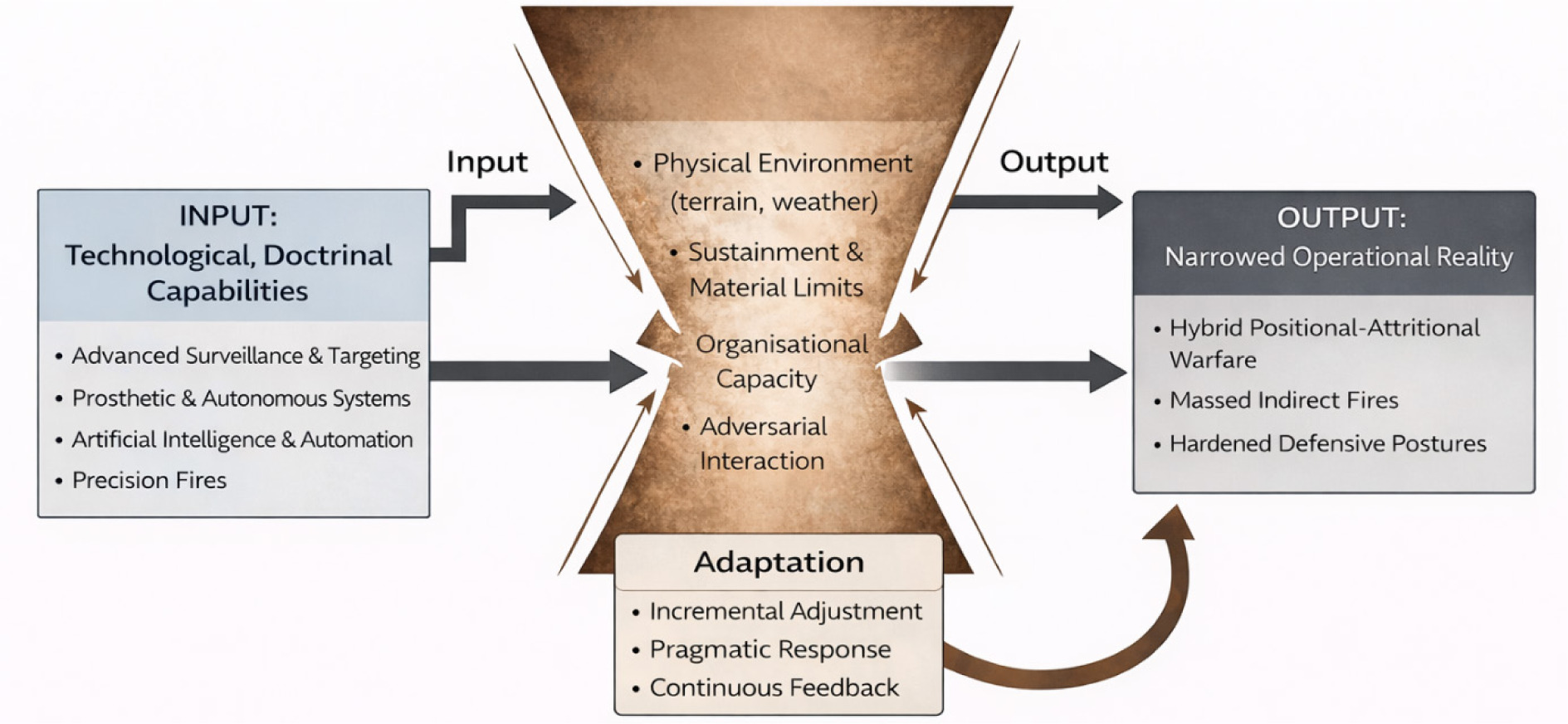
Figure 1 presents contemporary warfare as a process shaped by selection under constraint, not as a linear story of technological transformation. Technological and doctrinal capabilities enter the battlefield environment but are actively filtered by a limited set of interacting constraints: the physical environment, sustainment and material limits, organisational capacity, and adversarial interaction. Through incremental and pragmatic adaptation, only those forms of force employment are able to function under sustained exposure and attrition persists. The outcome is a narrowed operational reality characterised by hybrid positional-attritional warfare rather than unconstrained manoeuvre or decisive technological dominance.
Discussion
As conceptualised in the battlefield filtering model (Figure 1), technological innovation in Ukraine did not expand the space of military choice but progressively constrained it through the cumulative pressure of operational conditions. Patterns visible across the literature challenge the view that contemporary warfare is driven primarily by technological acceleration. While the war in Ukraine has demonstrated rapid diffusion of new systems, their operational impact has been shaped throughout by constraints cutting across domains, not isolated to individual technologies. What emerges is not a hierarchy of platforms, but a pattern of selective survival: capabilities persist to the extent that they remain usable under sustained exposure, attrition, and organisational strain.
High battlefield transparency plays a central role in this process, but not in the manner often assumed. Persistent surveillance neither eliminates uncertainty nor enables continuous manoeuvre. Transparency functions as a selection mechanism, narrowing the range of viable force employment by raising the costs of error and misalignment between capability, environment, and organisation. Practices that depend on uninterrupted conditions or low loss rates struggle to scale. Those that tolerate disruption and degradation persist. In Ukraine, this took a concrete form: unguided artillery, commercial drones, and legacy armoured systems continued to operate side by side. Operational relevance increasingly depends on whether a capability can absorb loss without collapsing organisational tempo or logistical capacity. This logic cuts across traditional distinctions between “high-tech” and “low-tech” systems, suggesting that technological advantage is less a function of performance thresholds than of endurance within constrained operational envelopes. The four filters: physical environment, sustainment, organisational capacity, and adversarial interaction, do not operate as a single, coordinated mechanism. Any one of them can be enough to sideline a capability. Terrain may blunt a system’s advantages. Logistical disruption can halt its use, and organisational limits can prevent lessons from being absorbed. More often, these pressures overlap. When they do, the room for effective employment narrows quickly. The filtering process is therefore neither linear nor predictable: it is the pattern of their interaction, not the presence of any single constraint, that determines which capabilities retain operational relevance over time.
The organisational dimension of adaptation is critical in this regard. Access to information, sensors, or captured materiel generates operational advantage only when institutions can absorb and act on it. As the analysis of technical exploitation demonstrates, the bottleneck lies not in collection but in integration. Rietveld’s (2025) work highlights a persistent capability gap in which most forces remain limited to basic field recovery, while higher-level analysis is externalised to civilian infrastructure. The result is a temporal disconnect: information is generated rapidly but converted into actionable adaptation slowly. In effect, the acceleration enabled by digital sensing is absorbed and often neutralised by organisational inertia.
There is also a structural reason why this lag persists even in militaries that are strongly motivated to adapt. Rosen (1991), drawing mainly on the US military policy between 1905 and 1960 as well as British armoured warfare during the First World War, argued that wartime innovation is constrained less by institutional conservatism than by the epistemic limits of combat itself. Under battlefield conditions, it is often difficult to determine whether a tactical change genuinely improved performance or whether success resulted from more favourable circumstances. The fog of war therefore generates not only operational friction but also organisational uncertainty, because commanders lack clear feedback about whether adaptation is effective.
This uncertainty reinforces the institutional inertia identified by Hunzeker and Harkness (2021) as well as Adamsky (2010) at the level of doctrine and cognitive style. In Ukraine, the result is a persistent gap between the pace at which battlefield conditions evolve and the slower process through which military organisations absorb, assess, and institution-alise new responses.
This temporal mismatch has broader implications. When adaptation cycles lag behind battlefield change, technological advantages quickly become temporary as adversaries adjust and countermeasures spread. Research on military adaptation therefore emphasises the organisational dimension of learning. Ryan (2024) describes adaptation as the continual recombination of technology, personnel, and ideas, while Hunzeker and Harkness (2021) show that effective adaptation depends on institutionalised feedback loops capable of translating battlefield experience into operational change. Where such mechanisms functioned effectively, units adapted more successfully; where they did not, organisational inertia blunted the advantages created by new technologies.
Adamsky’s (2010) analysis of how strategic culture shaped the reception of IT-RMA in Russia, the United States, and Israel points to a similar conclusion. Institutional cognitive styles, he argues, play a decisive role in determining whether technological change is translated into effective operational practice. This perspective helps to explain why units with broadly comparable access to equipment in Ukraine often achieved very different operational results. The Ukrainian case broadly supports this view, with an important qualification: adaptive capacity was uneven. Units able to shorten feedback loops between observation and modification proved more resilient, while those constrained by rigid command structures lagged behind. Organisational integration shaped battlefield performance more consistently than access to new systems. Under such conditions, the decisive variable is not innovation itself but the capacity to shorten feedback loops between observation, learning, and modification. Organisational structures that cannot sustain this cycle under combat conditions systematically underperform, regardless of their access to advanced systems.
The patterns identified across the literature also complicate linear models of military transformation. Technological innovation in Ukraine has not produced cumulative change. It has generated partial, uneven adaptation across a battlefield that resists wholesale transformation. Capabilities enter the battlefield rapidly, but many are pushed to the margins just as quickly. Combinations of practices aligned with enduring constraints, such as terrain, force density, sustainment, and human endurance, prove durable. Doctrinal templates do not. Change occurs through contraction as much as through expansion, as forces abandon options that prove too expensive under exposure.
In Ukraine, technological effectiveness depended less on novelty than on whether capabilities could remain operational under sustained exposure, attrition, and organisational strain. RAND Corporation analyses similarly emphasise that industrial depth, competence, and replacement capacity mattered at least as much as platform sophistication (Hvizda et al., 2025). Persistent surveillance and long-range fires increased the costs of offensive action and reinforced positional and attritional forms of warfare. The constraints shaping battlefield outcomes were therefore industrial, organisational, and environmental as much as technological.
The Ukrainian case points to a recurring dynamic. Investment in advanced systems did not translate automatically into sustained advantage. In cases where organisational capacity, logistical depth, and learning mechanisms lagged behind, early gains faded under pressure. The decisive factor was the fit between the capability and the structures meant to employ it. In this conflict, effectiveness aligned more consistently with organisational endurance and logistical depth than with the technical generation of the systems employed.
Conclusions
The recurrence of similar constraints across domains as different as drone warfare, armoured manoeuvre, and urban combat and across successive phases of the conflict, points to a common underlying logic. Operational environments do not eliminate capabilities through a single decisive factor; rather, they progressively narrow what remains usable as physical conditions, logistical limits, and organisational pressures accumulate over time. This is the dynamic captured by the battlefield filtering model proposed here. The Russia–Ukraine war confirms something more precise than the proposition that technology transforms warfare. Technology changes how warfare is conducted, but its effects remain conditioned by enduring environmental, logistical, and organisational factors that define the limits of its practical utility. What the conflict demonstrates, above all, is a process of selection rather than replacement: practices that tolerate attrition, organisational strain, and environmental degradation persist; those that depend on uninterrupted conditions do not. The reappearance of the precision-degradation dynamic in the northern Gaza Strip, an operational environment that differs from Ukraine in most political and organisational respects, suggests that this pattern is not unique to the Ukrainian case. Rather, it points to a broader feature of sustained urban and high-intensity combat, in which operational conditions progressively limit the effectiveness of precision capabilities.
The existing frameworks help to explain the conditions that shape force employment at a particular moment. The filtering model proposed here focuses instead on how these conditions interact over time and gradually narrow the range of operational options. In doing so, it introduces a temporal dimension, the cumulative effect of constraints that earlier accounts have largely left unexplored. The analysis suggests that military effectiveness in contemporary conflict is shaped less by the possession of novel systems than by the capacity to sustain adaptation under pressure. Forces that keep feedback loops short between observation, learning, and action adapt. Those whose organisational structures, fragmented by bureaucracy, dependent on externalised expertise, or slowed by institutional inertia, cannot sustain the cycle find that technological advantages dissolve before they are institutionalised. The bottleneck is rarely the technology itself.
The argument carries three broader theoretical implications. The first concerns temporality. The filtering model extends Biddle’s (2004) framework by focusing not only on which operational practices remain viable under a given set of conditions but on how those conditions themselves deteriorate under sustained battlefield pressure.
It also shifts attention away from technological capability in isolation and towards the organisational and environmental conditions that determine whether a capability can remain operational under attritional pressure. In doing so, the model challenges a central assumption in much of the military transformation literature: that battlefield effectiveness derives primarily from technological sophistication.
The argument further raises questions about the scope conditions of filtering that the existing scholarship has not examined systematically. Under which combinations of operational intensity, industrial capacity, and organisational resilience does the narrowing of viable force employment options accelerate, and under which conditions does it slow? Ukraine provides unusually rich empirical material for beginning to address these questions, but identifying the limits of the model’s applicability will require structured comparison with conflicts in which attrition remained less intense.
Several research directions follow from this. Comparative analysis across conflicts with lower levels of attrition would help clarify both applicability and limits of the model. Another concerns the role of technical exploitation as an organisational variable. Rietveld’s (2025) work points to a persistent gap between information collection and adaptive action that remains insufficiently examined in relation to battlefield performance. A further issue concerns the relationship between industrial depth and the pace at which operational constraints emerge. The Ukrainian case suggests that the decisive limits of prolonged high-intensity warfare are organisational and industrial before they are technological, yet the existing theories of military effectiveness still provide only limited accounts of how these pressures evolve over time. The model is likely to be least applicable in conflicts characterised by rapid decision cycles, low force density, and limited duration, where operational pressures may not persist long enough for cumulative filtering effects to emerge clearly. Future research could further operationalise the filtering model through quantitative indicators, including the relationship between sustained attrition, industrial replacement capacity, and changes in the diversity of force employment practices across successive phases of conflict.
Standard measures of force development, especially those centred on platform performance under ideal conditions, offer little guidance in assessing durability under sustained pressure. Systems that perform impressively in controlled environments frequently lose coherence once attrition, logistical strain, and adversarial counter-adaptation accumulate. In the Ukrainian case, resilience, industrial depth, and organisational learning capacity aligned more closely with sustained effectiveness than did platform-level performance metrics.
The analysis relies mainly on open-source institutional assessments rather than primary fieldwork. This limits the level of details available on organisational dynamics and unit-level adaptation. As with any interpretive synthesis, the framework is also shaped by the quality and assumptions of the sources on which it draws. Where institutional studies share similar methodological limitations or analytical blind spots, these may also be reflected in the filtering model. The iterative logic of CIS partly reduces this risk by drawing on sources from different disciplinary traditions and selecting them for their theoretical relevance rather than simply aggregating findings from a single body of literature. Even so, it cannot remove the limitation entirely. The reference to Gaza, while analytically useful, remains limited in scope and is based on a narrower evidential base than the Ukrainian case. Finally, the filtering model should be understood as an analytical framework rather than a predictive tool: it highlights the conditions under which capabilities lose operational relevance, but it cannot determine in advance which systems will remain viable in any particular conflict. The war in Ukraine has not resolved debates about the future of warfare. It has redirected them. The central issue is no longer technological dominance but which combinations of capability, organisation, and environment remain workable under sustained pressure.