


Introduction
Recent climate-related disasters have increased both frequency and complexity of emergency response operations, placing growing demands on military forces supporting civilian authorities. Flood events, in particular, expose deployed personnel to rapidly changing biological, chemical, physical, and ergonomic hazards that cannot always be anticipated during pre-deployment planning (Johanning et al., 2014; Kouadio et al., 2012). Within disaster risk reduction (DRR), protecting responders from these hazards is essential not only for occupational safety but also for maintaining operational capability, mission continuity, and the overall response effectiveness (Ein et al., 2024).
In the Czech Republic, the Czech Armed Forces (CAF) constitute an integral component of the integrated rescue system and are regularly deployed to support civilian authorities during large-scale emergencies when civilian response capacities are exceeded (Oulehlova et al., 2021). Although the legislative framework clearly defines responsibilities for occupational safety and personal protective equipment (PPE), compliance with regulatory requirements does not necessarily ensure that protective equipment adequately reflects the dynamic and multi-hazard conditions encountered during disaster response operations (Czech Republic, 2006, 2021).
Recent disaster logistics research emphasises that effective emergency response depends on adaptive resource allocation, situational awareness, and the ability to respond to evolving operational conditions rather than relying solely on predefined procedures or inventory availability (Ein et al., 2024).
The existing research has addressed occupational safety standards, emergency logistics, and military support to civil authorities, yet these areas have largely developed independently. Consequently, limited attention is devoted to how operational risk assessment, logistical decision-making, and PPE allocation interact during real disaster response operations. Moreover, empirical evidence derived from military flood-response deployments remains scarce, particularly within the European civil–military disaster response systems.
This study addresses this gap through an exploratory case study of CAF’s participation in the 2024 flood response. Based on interviews, questionnaire data, and systems-based causal analysis, it develops an empirically informed conceptual framework integrating hazard-specific PPE requirements with adaptive provisioning principles. The proposed dual-tiered modular framework is intended to support future research and the practical development of adaptive PPE provisioning in military disaster response.
Accordingly, the study addresses the following two research questions:
RQ1: To what extent do environmental variability and operational context require differentiated PPE configurations during military flood response operations?
RQ2: How can empirical findings from the CAF’s 2024 flood response inform the development of a dual-tiered modular framework for adaptive PPE provisioning in military disaster response?
Literature review and theoretical background
Personal protective equipment in disaster response
Personal protective equipment constitutes one of the primary risk-control measures used to reduce occupational exposure to hazards that cannot be eliminated through engineering, collective, or organisational controls (Czech Republic, 2021; European Union, 2016). Within DRR, PPE represents an essential component of responder safety, supporting not only individual protection but also the continuity and effectiveness of emergency response operations. International and national regulatory frameworks classify PPE according to the level of protection provided against specific categories of hazards, distinguishing between equipment intended for minor, moderate, and life-threatening risks (European Union, 2016). These standards establish minimum technical and performance requirements that ensure a consistent level of protection across occupational settings.
However, although these regulatory frameworks provide an indispensable foundation for occupational safety, they are developed primarily for relatively stable working environments in which hazards can be identified and assessed in advance. Disaster response operations differ fundamentally from such conditions. Flood-affected environments are characterised by rapidly changing combinations of biological, chemical, physical, and ergonomic hazards that frequently evolve during the course of a single deployment (Johanning et al., 2014; Kouadio et al., 2012). Consequently, compliance with the existing PPE standards does not necessarily guarantee that responders receive protection corresponding to the actual operational risk profile.
This limitation becomes even more pronounced in military disaster response. Unlike civilian emergency responders, military personnel operate under conditions where standard military equipment frequently performs both operational and protective functions. Requirements for mobility, durability, interoperability, and mission readiness therefore interact with occupational safety requirements, creating potential trade-offs between operational effectiveness and the level of individual protection. Standardised PPE allocation may consequently prove insufficient when personnel perform diverse tasks under highly variable environmental conditions.
Previous studies have shown that the protective effectiveness of PPE depends not only on its technical characteristics but also on its suitability for specific operational conditions (Veer and Sharma, 2025). Prolonged exposure to moisture, contamination, and physical workload may reduce the practical effectiveness of otherwise compliant equipment, while ergonomic incompatibility and material degradation can increase physiological strain, reduce mobility, and compromise operational performance (Havenith, 1999; Lunerová et al., 2023; Rebmann et al., 2011). These findings indicate that effective PPE provisioning in disaster response should extend beyond regulatory compliance and equipment availability by reflecting the dynamic interaction between operational tasks, environmental hazards, and responder requirements. This perspective provides the theoretical basis for considering PPE provisioning as an adaptive rather than purely inventory-based process.
Adaptive disaster logistics and risk-based PPE provisioning
Disaster response logistics differ fundamentally from conventional logistics because demand, infrastructure availability, operational priorities, and environmental conditions evolve continuously throughout emergency operations. Consequently, effective disaster logistics emphasise adaptability, flexibility, and rapid decision-making rather than optimisation under stable operating conditions.
These requirements are particularly relevant in military disaster response, where operational tasks and hazard exposure frequently change during deployment. Under such conditions, PPE provisioning should be regarded not merely as an inventory management function but as an adaptive logistics capability that aligns protective resources with evolving operational risks.
In this study, adaptive PPE provisioning is defined as the capability of a logistics system to adjust PPE allocation according to changing environmental hazards, operational tasks, and responder requirements while maintaining operational continuity and logistical feasibility. This perspective extends conventional inventory-based approaches by explicitly integrating operational risk assessment into provisioning decisions.
The concept is consistent with resilience engineering, which emphasises a system’s capacity to anticipate, monitor, respond, and learn under changing operational conditions. Accordingly, adaptive PPE provisioning seeks not only to ensure equipment availability but also to maintain effective responder protection despite uncertainty and evolving hazard conditions.
Military–civilian disaster response and international approaches to PPE provisioning
The growing involvement of armed forces in domestic disaster response has increased the importance of interoperability between military logistics and civilian emergency management systems (Oulehlova et al., 2021). Beyond operational coordination, interoperability also encompasses occupational safety, risk assessment, and PPE provisioning. Although many countries apply internationally harmonised occupational safety standards, practical approaches to PPE allocation differ according to organisational structures, operational doctrines, and disaster preparedness strategies.
Comparative analysis identifies three principal approaches to PPE provisioning in military disaster response (Table 1). The first emphasises regulatory harmonisation, where PPE allocation is primarily based on compliance with occupational safety legislation and technical standards. Germany exemplifies this approach through strong integration of military support with civilian regulatory frameworks, ensuring high interoperability but offering limited operational flexibility (Papadakis et al., 2024).
Table 1
Comparison of international approaches to PPE provisioning in military disaster response.
The second approach focuses on hazard-specific operational adaptation, in which PPE selection is linked directly to identified environmental risks and operational tasks. This model is reflected in disaster response practices in the United States, where operational risk assessment considers diverse environmental conditions, workload, and PPE-related factors (Grundstein et al., 2025).
The third approach applies modular PPE provisioning, allowing equipment configurations to be adapted according to changing operational requirements. The Polish Territorial Defence Forces illustrate this concept by combining standardised individual equipment with equipment configurations adapted to specific operational environments (Goniewicz et al., 2019; Jałowiec and Spychalski, 2025; Kośka, 2024).
Despite their differences, all three approaches seek to balance standardisation with operational flexibility. Standardisation supports interoperability, procurement efficiency, and regulatory compliance, whereas adaptive and modular concepts improve the ability to respond to evolving operational risks. This balance provides a theoretical foundation for the adaptive dual-tiered modular framework proposed in this study.
Operational hazards and PPE requirements in flood response
Flood response operations expose responders to multiple interacting biological, chemical, physical, and ergonomic hazards whose intensity and distribution frequently change throughout deployment (Johanning et al., 2014; Kouadio et al., 2012). Unlike conventional occupational settings, disaster environments are characterised by uncertainty, rapidly evolving exposure conditions, and diverse operational tasks. Consequently, PPE requirements cannot be determined solely by predefined equipment categories but should reflect the interaction between environmental hazards, mission characteristics, and operational duration.
Biological hazards arise primarily from contact with contaminated floodwater, sewage, and decomposing organic material, increasing the risk of infectious diseases (Johanning et al., 2014; Kouadio et al., 2012). Chemical hazards result from exposure to industrial runoff, fuels, agricultural pollutants, and wastewater, requiring flexible respiratory and dermal protection because contaminant composition is often unknown during the initial response phase (Kouadio et al., 2012).
Physical and ergonomic hazards are associated with prolonged work in cold water, unstable terrain, manual debris removal, and the operation of heavy equipment. These conditions increase physiological strain, fatigue, and material wear, reducing both PPE effectiveness and responder performance (Havenith, 1999; Lunerová et al., 2023). Flood response operations also involve repeated exposure to high noise levels generated by chainsaws, pumps, demolition equipment, and heavy machinery, although hearing protection often receives less attention than other protective measures.
Collectively, these hazards demonstrate that effective PPE provisioning requires more than compliance with technical standards or equipment availability (Table 2). Rather, responder protection should be adapted to changing operational conditions and evolving hazard profiles, providing the rationale for the adaptive provisioning approach developed in this study.
Table 2
Operational hazards and corresponding PPE requirements in flood response operations.
Theoretical Background and Research Gap
The reviewed literature demonstrates considerable progress in occupational safety, disaster logistics, and military support to civil authorities. Regulatory frameworks define technical requirements for PPE (Czech Republic, 2021; European Union, 2016). Disaster logistics research increasingly emphasises adaptability and resilience under uncertainty, and studies on civil–military cooperation highlight the importance of interoperability during disaster response (Goniewicz et al., 2019; Oulehlova et al., 2021).
Despite these advances, three important gaps remain. First, PPE provisioning predominantly has been examined from regulatory or occupational safety perspectives, with limited attention to its role as an adaptive logistics capability. Second, empirical evidence on adapting PPE allocation to changing operational conditions during military disaster response remains scarce. Third, few studies integrate operational experience, responder perceptions, and systems-based causal analysis within a single analytical framework.
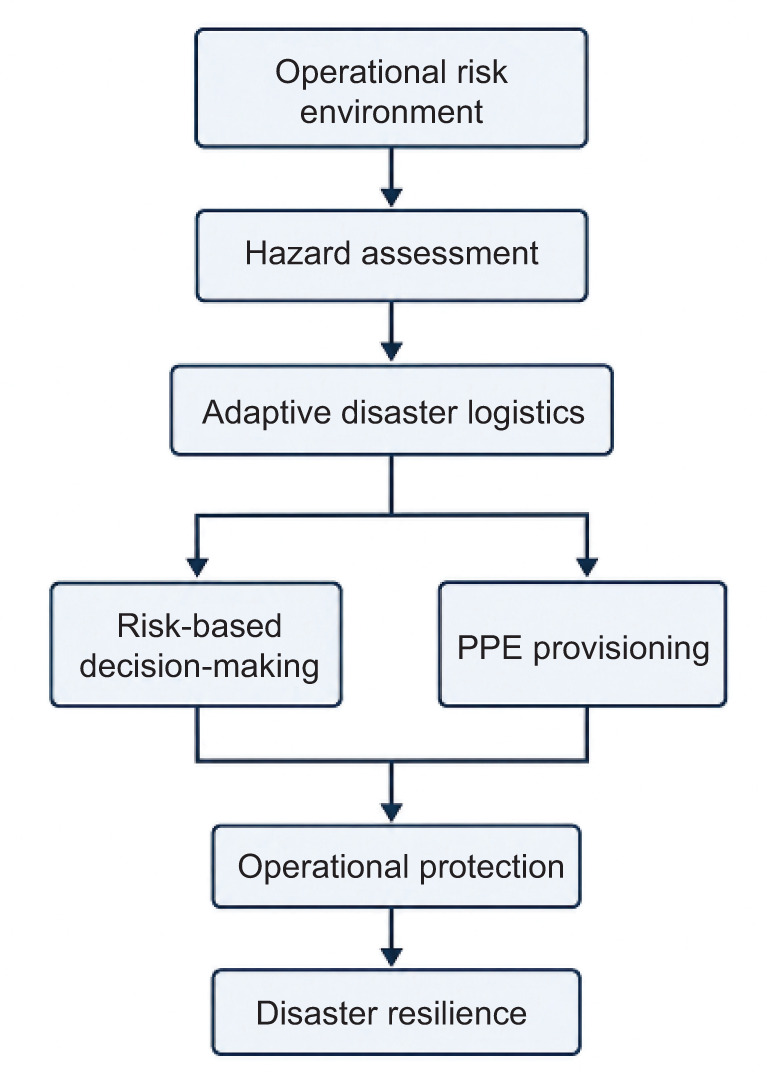
To address these gaps, this study adopts an exploratory case-study approach based on CAF’s participation in the 2024 flood response. By integrating interviews, questionnaire data, and systems-based causal analysis, the study develops an empirically informed conceptual framework for adaptive PPE provisioning. Figure 1 summarises the theoretical relationships underpinning the proposed framework.
Methodology and research design
Research design
This study employed a qualitative-dominant mixed-methods design within an exploratory single-case study framework to investigate PPE provisioning during the CAF deployment in response to the 2024 floods. The case study approach was selected because it enables in-depth examination of complex organisational processes in their real-world operational context, where the boundaries between the phenomenon and its environment are not clearly defined (Yin, 2018).
Qualitative data provided insight into organisational decision-making, logistical processes, and operational experience, while quantitative questionnaire data described patterns of PPE allocation, availability, and user perceptions across participating military units. Integrating these data sources enabled methodological triangulation and strengthened credibility of the findings (Lincoln and Guba, 1985).
Data collection
Field data collection was conducted jointly with Pavla Davidová, as part of a broader research collaboration examining PPE provisioning during the 2024 CAF flood response, which also informed a related graduate thesis conducted under her supervision.
Semi-structured expert interviews
Semi-structured expert interviews were conducted with eight CAF personnel serving in command and staff positions across three military units involved in the 2024 flood response. Participants were selected using purposive sampling based on the following three inclusion criteria:
A minimum of 3 years of active military service.
Responsibility for logistics, equipment management, or PPE distribution.
Direct operational experience during the 2024 flood response or comparable civil–military emergency deployments.
Purposive sampling was selected to ensure that interview participants possessed substantial operational expertise directly relevant to the research objectives (Ahmad and Wilkins, 2025; Meuser and Nagel, 2009).
Interviews followed a semi-structured guide covering PPE allocation, logistical coordination, operational decision-making, and perceived shortcomings. Questions were adapted to respondents’ professional experience while maintaining comparability across interviews (Kvale and Brinkmann, 2015).
Questionnaire survey
A standardised electronic questionnaire was administered to CAF personnel who participated directly in the 2024 flood response operations.
The survey employed purposive sampling and included personnel from three military units representing different operational and logistical functions within CAF: (1) 71st Mechanised Battalion Hranice, (2) 14th Logistics Support Regiment Pardubice, and (3) Training Command—Military Academy Vyškov (supported by the Vyškov Support Battalion for PPE distribution).
Eligibility criteria were: (1) direct deployment during the 2024 flood response, (2) assignment to one of the participating military units, and (3) voluntary informed consent. No personally identifiable information was collected.
The questionnaire comprised eighteen items combining closed-ended questions with one open-ended question. The complete questionnaire, including the wording of all items and response options, is provided in Appendix. The questionnaire was organised into four analytical domains:
Deployment characteristics of respondents.
PPE allocation, availability, and operational use during flood response.
Organisational and logistical aspects of PPE provisioning, including equipment distribution, replenishment, and coordination.
Recommendations for improving PPE provisioning.
This structure enabled the collection of information describing both operational outcomes and the organisational processes influencing PPE provisioning.
A total of 108 valid questionnaires (N = 108) were obtained.
Participation in both interviews and questionnaire survey was voluntary. All participants were informed about the purpose of the study prior to participation. Questionnaire responses were collected anonymously, interview transcripts were anonymised before analysis, and no personally identifiable information was retained. The study complied with applicable ethical principles governing social science research involving CAF personnel.
Data analysis
Quantitative questionnaire data was analysed using descriptive statistics, whereas qualitative interview transcripts and open-ended questionnaire responses underwent reflexive thematic analysis. Both datasets were subsequently integrated through systems-based causal analysis to identify organisational and logistical factors influencing PPE provisioning during flood response operations. The questionnaire consisted of closed-ended items and one open-ended question (see Appendix).
Quantitative analysis
Closed-ended questionnaire items were analysed using descriptive statistics (absolute and relative frequencies and percentage distributions) to describe PPE allocation, availability, operational use, and respondents’ perceptions of equipment functionality. Given the exploratory nature of the study and its emphasis on understanding organisational processes rather than testing statistical hypotheses, no inferential statistical analyses were performed. The results are presented primarily in graphical form to facilitate comparison across the participating military units.
Qualitative analysis
Qualitative data comprised interview transcripts and responses to the open-ended questionnaire item. The data was analysed using reflexive thematic analysis following Braun and Clarke’s (2006) six-phase framework. Coding was conducted inductively, allowing themes to emerge from the empirical material without predefined analytical categories (Braun and Clarke, 2006, 2022). Open-ended questionnaire responses were analysed using the same coding procedure, enabling comparison across qualitative data sources and supporting methodological triangulation. Questionnaire items, response options, and the overall structure are presented in the Appendix to enhance methodological transparency and facilitate future replication.
Coding proceeded through Braun and Clarke’s (2006) six phases, from initial familiarisation and line-by-line coding to the collating of codes into themes and their subsequent review and refinement. This process yielded six analytical themes—personnel, equipment/material, operational environment, methods, logistics, and organisational processes—each comprising two to four sub-themes grounded in recurring patterns across interview transcripts and open-ended questionnaire responses (Table 3). These themes subsequently served as the structural basis for the Ishikawa (fishbone) causal categories presented in the “Results” section, providing an explicit link between the coding process and the systems-based causal analysis.
Table 3
Coding themes and sub-themes.
Systems-based causal analysis
An Ishikawa (fishbone) diagram was used to synthesise the organisational and logistical causes of PPE provisioning deficiencies. The identified factors were grouped into six categories—personnel, equipment, logistics, organisational processes, operational environment, and methods—forming the analytical basis for the proposed dual-tiered modular framework.
Quality assurance and trustworthiness
In order to ensure the trustworthiness of qualitative findings, the study followed the quality framework proposed by Lincoln and Guba (1985), addressing credibility, transferability, dependability, and confirmability. Credibility was strengthened through methodological triangulation by systematically comparing findings obtained from expert interviews with both quantitative questionnaire results and qualitative responses to the open-ended survey question. Transferability was supported by providing a detailed description of operational context, participant selection procedures, and organisational characteristics of the participating military units, enabling readers to assess the applicability of the findings to comparable disaster-response settings. Dependability was enhanced through the maintenance of an audit trail documenting coding decisions, theme development, and analytical procedures throughout the study. Finally, confirmability was promoted by grounding all interpretations directly in empirical evidence while maintaining researcher reflexivity during coding and interpretation (Braun and Clarke, 2022; Lincoln and Guba, 1985).
Analytical framework
The analytical framework integrated qualitative interviews, questionnaire data, reflexive thematic analysis, descriptive statistical analysis, and structured causal analysis to examine PPE provisioning from complementary methodological perspectives. The combination of these methods enabled the identification of both operational deficiencies and organisational mechanisms influencing PPE provisioning during flood response operations. The resulting evidence provided the analytical basis for developing the proposed dual-tiered modular framework presented in the subsequent “Results” section.
Results
Operational characteristics of deployment
Table 4 summarises the operational characteristics of personnel participating in the CAF 2024 flood response operations. The majority of respondents (86.1%) were engaged in debris and mud removal, while 13.9% performed machinery and vehicle operation tasks. Most personnel (73.1%) remained deployed for more than 7 days, indicating prolonged exposure to demanding field conditions. Furthermore, 91.7% of personnel participated in stabilisation and clean-up activities, whereas 55.6% were involved in infrastructure restoration.
Table 4
Operational characteristics of respondents (N = 108).
The survey also showed that previous experience with comparable operations was relatively limited. For 61.1% of respondents, the 2024 floods represented their first crisis-response deployment. One-third (33.3%) had participated in another type of crisis operation, while only 5.6% of respondents reported previous experience with flood-response deployments.
Overall, the respondent profile represents personnel who were predominantly engaged in prolonged field operations under demanding environmental conditions, providing an appropriate empirical basis for assessing PPE provisioning during military flood response.
PPE availability and operational suitability
Table 5 summarises the availability of PPE reported by respondents during the 2024 flood response operations. Protective gloves were available to all respondents (100%), representing the only PPE category with universal distribution. Respiratory protection was available to 55.6% of respondents, while protective footwear was reported by 50.0% of respondents. Lower availability was observed for eye and face protection (39.8%) and protective suits (18.5%).
Table 5
Availability of personal protective equipment (PPE) reported by respondents during flood response operations.
| PPE type | Response equipped (%) |
|---|---|
| Protective gloves | 100.00 |
| Respiratory protection | 55.60 |
| Protective footwear | 50.00 |
| Eye/face protection | 39.80 |
| Protective suits | 18.50 |
The findings indicate considerable variation in the availability of specialised protective equipment across different PPE categories. While basic protective items were consistently issued, equipment intended to address specific biological, chemical, and environmental hazards was reported less frequently.
In addition to standard PPE, respondents frequently reported the use of disinfectants to support hygiene measures and reduce secondary contamination during operations. Although disinfectants are not classified as PPE under the European regulatory framework (European Union, 2016), they formed part of routine protective practices during flood response activities. This practical need was also reflected in the interviews.
Respondents also identified repeated exposure to high-noise environments generated by chainsaws, pumps, hydraulic rescue equipment, and heavy machinery. Despite the widespread occurrence of these activities, hearing protection was not consistently available according to questionnaire responses.
The survey further indicated that most personnel received PPE before deployment, whereas additional equipment issued during ongoing operations was reported less consistently. Several respondents also noted that supplementary equipment was obtained from external sources, including municipal authorities and humanitarian organisations.
Besides equipment availability, respondents reported several limitations affecting operational use, including ergonomic mismatch, reduced comfort during prolonged wear, material degradation under wet conditions, and insufficient suitability for extended deployments. These observations complement the quantitative findings by highlighting practical aspects of PPE performance under demanding operational conditions. As one occupational safety specialist (unit B) noted: “The equipment generally fulfilled its protective function, but prolonged work in wet and muddy conditions quickly reduced both comfort and usability.”
Cross-hazard PPE deficiencies
The categories included in the Ishikawa diagram were derived through iterative thematic analysis by integrating questionnaire findings with recurring themes identified in semi-structured interviews. Each causal category was supported by multiple empirical observations rather than a single data source.
To examine PPE deficiencies from an operational perspective, the reported shortcomings were synthesised according to the principal hazard domains encountered during flood response operations. Rather than considering individual PPE items separately, this approach enabled the relationship between operational hazards, identified equipment gaps, and their potential operational consequences to be examined (Table 6).
Table 6
Reported deficiencies of personal protective equipment (PPE) across major operational hazard domains.
Table 6 demonstrates that PPE deficiencies were identified across all major hazard domains. Within the biological domain, respondents reported insufficient availability of protective suits for personnel working in contaminated water and mud, increasing exposure to biological contaminants. In the chemical domain, limited respiratory protection was reported in the environments affected by wastewater and industrial runoff.
This interpretation was supported by interview findings. As one occupational safety specialist (unit B) observed: “The protective equipment was generally suitable for routine military activities, but flood response exposed personnel to biological and chemical hazards that required different combinations of PPE.”
Ergonomic shortcomings were primarily associated with prolonged work under wet conditions, where respondents identified limitations related to footwear, sizing, and material performance. These factors were reported to reduce mobility and increase physical strain during extended deployments. In addition, respondents described repeated exposure to high-noise environments generated by chainsaws, demolition equipment, pumps, and heavy machinery, while hearing protection was not consistently available.
Taken together, the findings indicate that reported PPE deficiencies extended across biological, chemical, physical, and ergonomic hazard domains rather than being confined to a single category of operational risk. This synthesis provides the empirical basis for the subsequent systems-based causal analysis.
Systems-based causal analysis
To identify the organisational and logistical mechanisms underlying the reported PPE deficiencies, the qualitative findings were synthesised using a systems-based causal analysis based on the Ishikawa method (Figure 2). Rather than attributing deficiencies to isolated equipment shortages, the analysis identified multiple interacting factors affecting PPE provisioning during flood response operations.
Figure 2
Systems-based causal analysis of factors affecting PPE provisioning during flood response operations.
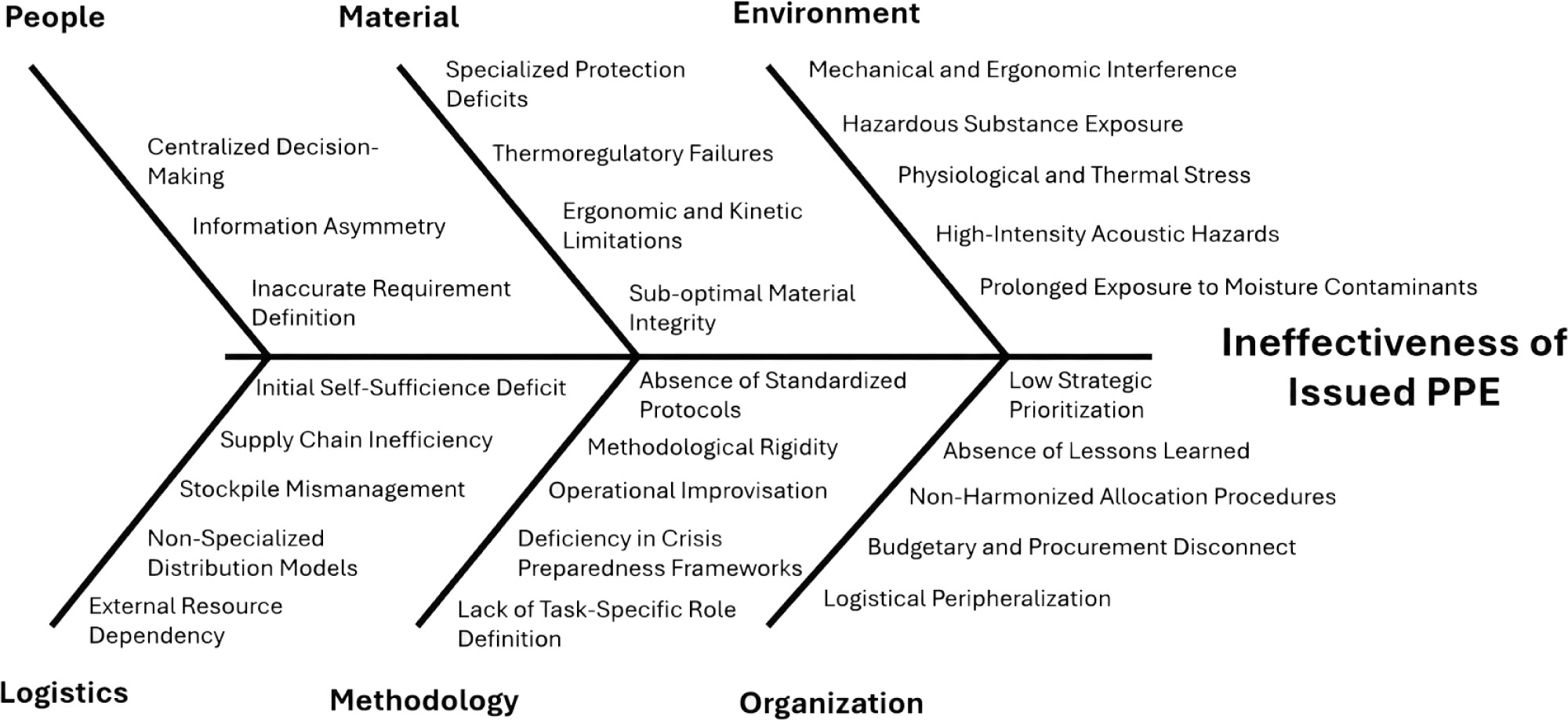
The causal structure revealed the following six interrelated categories influencing PPE allocation: (1) personnel, (2) equipment, (3) logistics, (4) organisational processes, (5) operational environment, and (6) methods. Deficiencies associated with hazard-specific PPE were found to result not only from equipment availability but also from planning procedures, communication, distribution processes, and the absence of systematic risk-based allocation mechanisms.
As one logistics officer (unit C) stated: “Our standard PPE inventories work well for routine military tasks, but flood response requires the ability to rapidly adapt equipment combinations to changing operational conditions.”
The analysis further demonstrated that several identified deficiencies were interconnected across multiple organisational levels. For example, delayed equipment distribution was associated with both logistical constraints and lack of predefined procedures for adapting PPE configurations to changing operational conditions. Similarly, ergonomic limitations and incomplete hazard coverage reflected not only equipment characteristics but also procurement priorities and operational planning practices.
Overall, the systems-based causal analysis suggests that improving PPE provisioning requires organisational adaptation in addition to expanding equipment inventories. These findings provided the analytical basis for developing the proposed dual-tiered modular framework presented in the following section.
Development of dual-tiered modular framework
The empirical findings, together with the systems-based causal analysis, provided the basis for developing the proposed dual-tiered modular framework for adaptive PPE provisioning during military flood response operations. Rather than representing a collection of independent recommendations, the identified organisational, logistical, and operational measures were synthesised into an integrated conceptual framework reflecting the principal deficiencies observed during the 2024 CAF flood response.
The framework was developed by linking the empirical evidence obtained from questionnaire survey and expert interviews with the causal relationships identified through the Ishikawa analysis. This synthesis enabled the transformation of individual operational observations into a structured model supporting adaptive PPE provisioning under dynamic disaster-response conditions.
Table 7 illustrates how specific empirical findings and their corresponding causal factors were translated into components of the proposed framework, providing an explicit traceability chain from data to the resulting model.
Table 7
Traceability of empirical evidence to framework components. Notes. UDK: universal deployment kit; SHK: specialised hazard kit.
Based on the synthesis of the empirical findings and the literature, the proposed dual-tiered modular framework integrates five complementary functional components designed to address the principal deficiencies identified in the existing PPE provisioning system. Together, these components improve baseline readiness, optimise mission-specific equipment allocation, expand protection against multiple hazards, and strengthen organisational learning and long-term adaptability. Table 8 summarises the functional components incorporated into the proposed framework together with their corresponding system-level measures and intended operational functions.
Table 8
Functional components of the proposed dual-tiered modular framework. Notes. UDK: universal deployment kit; SHK: specialised hazard kit.
The proposed framework should be understood as an integrated system rather than a collection of independent measures. Each component addresses a specific weakness identified during the empirical investigation, while their combined implementation enhances the overall resilience and adaptability of the PPE provisioning process. In particular, the framework combines immediate operational readiness through decentralised pre-positioned equipment with longer-term organisational adaptation supported by systematic risk-based allocation and institutional learning. This integrated approach enables the provisioning system to respond more effectively to diverse operational environments while continuously incorporating lessons identified from previous deployments.
The proposed framework consists of two complementary provisioning layers (Figure 3). The universal deployment kit (UDK) represents the baseline equipment package issued to all deployed personnel before deployment and provides immediate protection against hazards commonly encountered during flood response operations. In contrast, the specialised hazard kit (SHK) represents a modular extension activated according to site-specific operational risk assessment, enabling protective equipment to be adapted to changing environmental conditions, mission requirements, and identified hazard profiles.
Figure 3
Proposed dual-tiered modular framework for adaptive PPE provisioning. Source: Prepared by the authors using Claude AI.
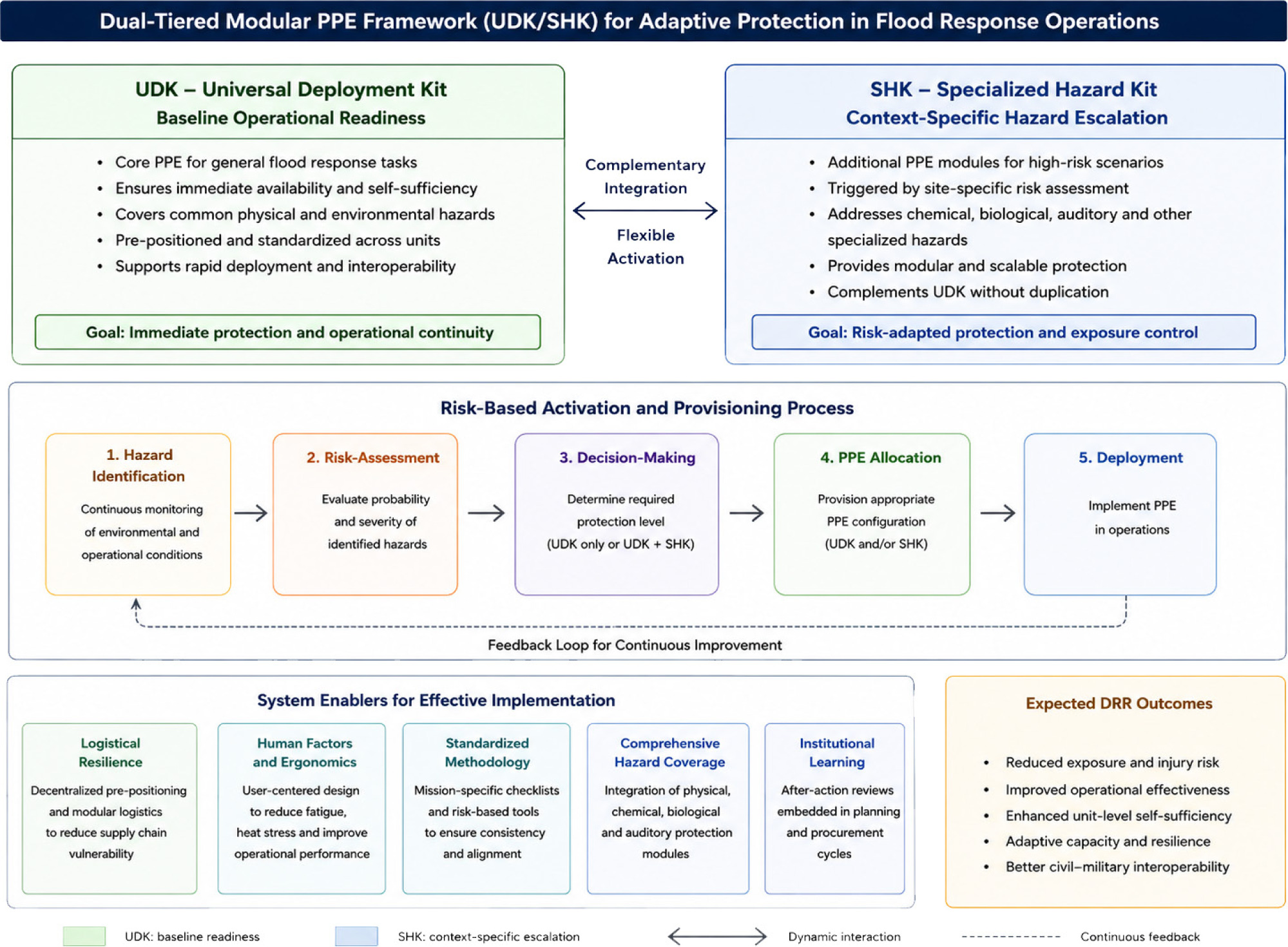
Unlike conventional PPE provisioning systems based primarily on predefined inventory structures, the proposed framework explicitly differentiates between universal deployment readiness and operational risk-specific protection. This distinction allows protective resources to be allocated according to the characteristics of the operational environment while maintaining standardised baseline equipment across all deployed personnel. The conceptual structure of the proposed dual-tiered modular framework is illustrated in Figure 3.
Discussion
From standardised to adaptive PPE provisioning
The findings suggest that conventional PPE provisioning systems, although compliant with occupational safety regulations, only partially address the dynamic conditions of military flood response. While baseline PPE was generally available, hazard-specific equipment was distributed less consistently, indicating a mismatch between operational risk and PPE allocation.
This interpretation was also reflected in participants’ operational experience. As one logistics officer (unit C) explained: “Routine logistics worked well, but flood response required equipment configurations that could be adapted quickly as operational conditions changed.”
These findings are consistent with disaster logistics and resilience research, which emphasise adaptive resource allocation and the ability to respond to changing operational conditions rather than relying solely on predefined procedures (Hollnagel, 2017).
The findings also complement previous occupational safety research. The existing regulatory frameworks provide comprehensive technical specifications for PPE performance and certification (European Union, 2016), yet they primarily assume relatively stable occupational environments. As noted by Johanning et al. (2014) and Kouadio et al. (2012), flood response operations expose personnel to rapidly changing combinations of biological, chemical, physical, and ergonomic hazards. The present findings suggest that compliance with technical standards alone does not necessarily ensure that PPE allocation corresponds to actual operational risk profiles during prolonged disaster response operations.
The international comparison presented in this study further supports this interpretation. The reviewed literature suggests that German approaches primarily emphasise regulatory harmonisation and standardised certification, whereas studies from the United States place greater emphasis on hazard-specific operational adaptation. The reviewed Polish literature describes a modular PPE concept that enables equipment configurations to be adjusted according to operational requirements (Goniewicz et al., 2019; Grundstein et al., 2025; Jałowiec and Spychalski, 2025; Kośka, 2024). The empirical findings from CAF do not indicate that one of these approaches should replace the others. Instead, they suggest that effective military disaster response requires combining standardised baseline equipment with sufficient operational flexibility to respond to evolving hazard conditions.
Taken together, these findings support the argument that PPE provisioning should be viewed not merely as an inventory management activity but as an adaptive component of military disaster logistics. Such an interpretation extends the existing literature by explicitly linking operational risk assessment, logistical decision-making, and responder protection within a single analytical framework.
Implications for civil–military disaster response
The proposed framework has implications beyond the military context, particularly for civil–military disaster response, where multiple organisations must coordinate under rapidly changing operational conditions. Rather than focusing solely on equipment availability, adaptive PPE provisioning may facilitate interoperability by providing a common risk-based approach to PPE allocation while allowing organisation-specific equipment configurations.
For military organisations supporting civilian authorities, the framework offers a structured mechanism for integrating standardised baseline equipment with mission-specific protective modules without compromising existing logistics procedures. This approach may improve coordination during joint operations by enabling responders from different organisations to operate under compatible risk-assessment principles while retaining organisational autonomy in equipment management.
More broadly, the framework highlights the importance of embedding operational risk assessment, modular PPE planning, and institutional learning within civil–military preparedness. These principles may support more resilient disaster-response systems capable of adapting responder protection to evolving hazard conditions while maintaining interoperability and logistical efficiency.
Theoretical contribution of the dual-tiered modular framework
The principal theoretical contribution of this study lies in conceptualising PPE provisioning as an adaptive logistics capability rather than solely an occupational safety or inventory management function. Previous studies have predominantly addressed PPE from regulatory, technical, or ergonomic perspectives (European Union, 2016; Havenith, 1999; Rebmann et al., 2011), whereas disaster logistics research has focused primarily on the allocation of relief resources without explicitly integrating responder protection into adaptive logistics models.
The proposed dual-tiered modular framework extends these research streams by linking operational risk assessment, logistical decision-making, and PPE allocation within a single conceptual model. By distinguishing between a UDK providing baseline readiness and an SHK activated according to mission-specific risk assessment, the framework introduces a structured mechanism for adapting responder protection to changing operational conditions.
Importantly, the proposed framework should be understood as an empirically informed conceptual model rather than a validated operational doctrine. Its primary contribution lies in providing a structured analytical perspective that may support future research on adaptive disaster logistics, military logistics, and occupational safety in complex emergency environments.
Practical implications
From a practical perspective, the findings suggest that improvements in PPE provisioning cannot be achieved solely through increasing equipment inventories. Instead, greater attention should be devoted to organisational processes governing equipment allocation, operational risk assessment, and logistical coordination throughout disaster response operations.
Within the proposed dual-tiered modular framework, the UDK would represent the standard PPE package issued to all deployed personnel regardless of mission type. This baseline configuration would typically include protective clothing, gloves, protective footwear, and other equipment required for general operational safety. The SHK would complement UDK by providing additional hazard-specific PPE, such as respiratory protection, chemical-resistant clothing, hearing protection, eye protection, or other specialised equipment identified through operational risk assessment.
Activation of SHK could be informed by pre-deployment hazard assessment and reviewed continuously with evolvement of operational conditions. Responsibility for recommending SHK activation should be assigned within the existing command and logistics structures according to the organisational structure and operational procedures of the respective military organisation. Such a structured decision-making process may improve the flexibility of PPE provisioning while maintaining compatibility with the existing military logistics procedures.
The proposed framework may support military organisations by encouraging the integration of modular PPE configurations into the existing logistics planning procedures. Such an approach would improve preparedness for prolonged deployments while maintaining compatibility with the existing procurement systems and occupational safety regulations. Rather than replacing the existing military logistics procedures, the proposed framework introduces an additional risk-informed decision layer that enables PPE configurations to be adapted to evolving operational hazards while preserving standardised procurement, inventory management, and distribution processes.
The findings also highlight the importance of incorporating after-action reviews into procurement and planning cycles, thereby enabling organisational learning from previous deployments and continuous refinement of PPE configurations.
Several practical observations emerging from this study also deserve attention. The repeated identification of insufficient hearing protection suggests that secondary hazards may receive less attention during operational planning despite their potential impact on responder safety and long-term occupational health. Similarly, ergonomic limitations associated with prolonged work under wet conditions indicate that equipment usability should be considered alongside compliance with technical performance standards when selecting PPE for disaster response.
Limitations and future research
This study has several limitations that should be considered when interpreting the findings. First, the research was based on a single exploratory case study of the CAF deployment during the 2024 floods. Consequently, the results should be regarded as analytically transferable rather than statistically generalisable to other military organisations or disaster contexts.
Second, the empirical analysis relied primarily on self-reported operational experience obtained through interviews and questionnaire responses. Although methodological triangulation strengthened the credibility of the findings, future research could complement these data with direct field observations, operational performance indicators, or longitudinal assessments conducted during disaster response exercises.
Finally, the proposed dual-tiered modular framework represents an empirically informed conceptual model whose operational effectiveness has not yet been validated. Future research should therefore examine its applicability across different disaster scenarios, military organisations, and multinational civil–military response environments. Comparative studies evaluating the framework under varying hazard conditions and organisational settings would further strengthen its practical and theoretical relevance.
Conclusions
This study examined PPE provisioning during the CAF’s 2024 flood response. The findings indicate that although baseline PPE was generally available, hazard-specific equipment was less consistently allocated, suggesting that regulatory compliance alone may not adequately address dynamic disaster-response conditions.
The study contributes to the existing literature by conceptualising PPE provisioning as an adaptive logistics capability rather than solely an inventory management function. Building on empirical findings, thematic analysis, and systems-based causal analysis, the research proposes the dual-tiered modular framework, which distinguishes between universal deployment readiness and hazard-specific operational adaptation. Rather than replacing the existing PPE systems, the framework offers a structured approach for integrating operational risk assessment into PPE allocation and supporting more flexible provisioning under changing disaster-response conditions.
From a practical perspective, the findings suggest that military organisations involved in disaster response may benefit from combining standardised baseline equipment with modular, risk-informed PPE configurations. Such an approach has the potential to improve responder protection, logistical flexibility, and interoperability between military and civilian emergency management systems while maintaining compatibility with the existing regulatory and organisational structures.
The study has several limitations. It is based on a single case study of the CAF flood-response operations and reflects the experiences of one national military organisation. Consequently, the findings should be interpreted as analytically transferable rather than statistically generalisable. In addition, the proposed framework represents an empirically informed conceptual model whose operational effectiveness has not yet been validated through field exercises or comparative international studies.
Future research should therefore evaluate the applicability of the proposed framework across different disaster scenarios, military organisations, and multinational civil–military response environments. Ultimately, adaptive PPE provisioning should be understood not only as a matter of equipment availability but as an integral component of resilient military disaster logistics capable of supporting responder safety under increasingly complex operational conditions.