
Introduction
After 80 years of neutrality, Finland, together with Sweden, opted for the membership of North Atlantic Treaty Organization (NATO) (De Fresnes et al., 2022; SVT, 2022). It was the Russian invasion into Ukraine on 24 February 2022 that prompted this historical turn. Despite the turmoil in Crimea and eastern Ukraine since 2014, the Russo-Finnish relations were widely polite, save the mutual economic sanctions. While inquired, the politicians from left to right spoke of “a NATO option,” and there reigned a tacit agreement. When the day comes, Finland shall muse on realising this opportunity; insofar, it is not actual. Even when the likelihood of an incursion into Ukraine increased in January 2022, the Finnish President Sauli Niinistö and his Russian counterpart Vladimir Putin exchanged thoughts on this development (Putin, 2022a).1 Their communication continued even after the launch of the “Special Military Operation”2 (Putin, 2022b). Yet, frightened of the events in Ukraine, Finland decided to adhere to NATO on 12 May 2022 (Government of Finland [GOF], 2022; for the stages of this turn among Finnish politicians and citizens in spring 2022, see, e.g. Forsberg, 2024, pp. 293–298).
The step hardly came as a surprise for Moscow. After 2 days, Niinistö and Putin discussed over the phone. According to a press release, Putin contented to state the course of the events. In the words of the Kremlin, the Finnish choice to renounce its “traditional policy of military neutrality” would prove “erroneous,” since there exist no menaces to Finland’s security. Moreover, such a foreign political turn might negatively affect the Russo-Finnish relations “which during many years have been based on good neighbourhood and a partner-like cooperation, carried a mutually beneficial character” (Putin, 2022c). In passing, one might discern an echo from the Treaty of Friendship, Cooperation and Mutual Assistance (Finnish abbreviation YYA) times in the 1950s–1980s, during which the Finnish-Soviet relations involved wide economic and cultural interactions. Regrettably, as these words are relayed by the presidential administration, we cannot deduce much. It is clear though that Putin astutely warned Finland over its future steps. Still, he emphasised economics/everyday relations, rather than military issues; the prolonged allusion to partnership and its benefits discloses this.
Hence, to trace Putin’s complete stance on Finland’s initial phases in NATO, I examine his topical articulation throughout 2022 and 2023. Van Leeuwen’s (2007) models of legitimisation are applied to Putin’s language and communication to disentangle the strategical narratives and possible discrepancies in his stance on Finland’s choice. How does the Russian president perceive the altered circumstances by the northwestern boundary and legitimise his standpoints? The inquiry reveals those linguistic and rhetorical strategies by which Putin negotiates and mitigates perchance the most unfavourable outcome of the invasion into Ukraine—that is, Finland’s (and Sweden’s) NATO membership. A systematic account of Putin’s idiom regarding Finland’s NATO decision assists to elucidate Russia’s strategic narratives more broadly, foremost the manners in which an authoritarian leader legitimises itself after an evident loss. Concomitantly, the article identifies flaws in Moscow’s practical NATO policy in relation to the generally adopted threat perception of NATO as a hazard to Russia.
The source material consists of President Putin’s Russian language comments on Finland and is obtained from the official site of the Kremlin (henceforth Putin). Notably, the period includes 8½ months after Finland’s NATO accession; this is to juxtapose, and thus to figure out the overall picture. To begin with, I discuss prior findings. Then, my material and methods are further clarified. This chapter is followed by a history of Russia–NATO relations, with Finnish foreign policy choices included. The results ensue, and to avoid tautology and to ease readability, I have organised these in two thematic sub-chapters. Finally, the references are listed. I wish to further knowledge on Putin’s—and Moscow’s—present (geo)political standpoints on Russia’s northwestern neighbour. The article offers background on those conundrums that emerge along/due to Finland’s NATO integration, today incorporated, for example, in a multi-corps land component command in Mikkeli, eastern Finland.
Notably, Putin legitimises Russia’s need to reinforce its military along the northwestern border by future developments, that is, the US contingents to be dislocated in Finland. As the Russian president regrets the gone lucrative neighbourhood, he applies storytelling and authorisation, that is, refers to the age-old profitable economic ties. Simultaneously, the financial benefits serve as an example of rationalisation for why Helsinki should not have opted for the alliance. Yet, Putin appears to benignly relate to the ordinary Finns. Here, we might observe aspects of moral evolution: the folks of Finland are innocent, unlike the élite. Still, Putin’s core objective was not to oppose or condemn Finland’s NATO path. Rather, it was to exhort Finland’s population to hamper collaboration with the United States, namely, their bilateral Defence Co-operation Agreement (DCA).
Literature review
Despite its inalienable link to the Russian general Arctic discourse—a profoundly investigated theme (e.g. Lamminparras, 2025a; Marsili, 2022; Godzimirski and Sergunin, 2020; Baev, 2018; Sergunin and Konyshev, 2016)—examinations on Moscow’s stance on a Finland seeking and/or obtaining NATO membership prove virtually non-existent. Even in fresh Russian research, either there manifest none or at best only a few quotes from Putin in each investigation; per se, the citations are the very same ones that I analyse below. Nonetheless, my inquiry is more than welcome and necessary: at times, the quotations of the Russian academics are indirect. Foremost, these scholars do not focus on Putin’s views—but those of Finnish top decision-makers and citizens (see, e.g. Smirnov, 2024; Yanglyayeva, 2024; Mezhevich, 2024; Lyuttser, 2022; Ponomaryeva, 2022; Zhilkin, 2022). Except for my own article on Putin’s topical discourse concerning Finland and Far North in 2024–2025 (Lamminparras, 2025b), a similar minimalism appears to characterise Finnish and European probes alike. For instance, in their case study of Finland as a target of Russian information warfare, Kari and Hellberg (2021) only once cite President Putin. Legucka’s (2022) bulletin on Russia’s stance on the Finnish and Swedish NATO bids makes no exception. Professor Forsberg (2024) merely alludes to “Putin’s demands” between late 2021 and early 2022, although the aim of his article is to provide a thorough account on the history and present NATO’s popularity in Finland. Apart from clarifying Finland’s policy during the Cold War era, Dinçer (2022) offers an intriguing explanation on how Finland securitised the Putin regime.
In a highly personalised power vertical, as in Russia, it is the top leader to set the parameters of language. As loyally though they might reproduce Putin’s conceptions, lesser cadres in the system are fundamentally bounden to plausible incongruities in the Kremlin’s over-arching narration. Thus, the Russian president’s quarter century in power has prompted plenty of research on his stimuli and utterances, much of which is conducted in Russia and/or by Russian-speaking academics (e.g. Andronova, 2015; Bekoyeva, 2015; Dement’yeva, 2009; Galyamina, 2016; Koteyko and Ryazanova-Clarke, 2009; Prozorov, 2004; Sedykh, 2012, 2016). In general, the Russian president underscores his message with collocations that combine concrete and figurative significances, thus rendering the speech more expressive (Sedykh 2012, pp. 40, 42). Bekoyeva (2015, p. 30) insists that one of the president’s main manoeuvres is the usage of “I,” with subsequent grammatical forms. Moreover, this manner does not contradict Putin’s way to often address issues in “we.” Dement’yeva (2009) focuses on Medvedev’s discourse, but she denotes how Putin initially contrasted his speak with that of his patron, Boris Yeltsin. While Yeltsin “conservatively” opposed the Soviet speak, Putin employed “a fresh young” idiom. Putin takes advantage of graduation (which during his first terms of economic growth often crystallised in “very good”) and personal pronouns. These are strengthened by his trustworthy tone. Unlike his then-successor Medvedev, Putin prefers an exclusive “we” (Dement’yeva, 2009, pp. 82–85).
Galyamina (2016, pp. 160, 165) further studied the use of the dichotomy “we” versus “they” in Putin’s articulation. She concludes that while Putin during the early years of his realm addressed from the perspective of the (whole) government, from 2014, he commenced to speak for the entire nation. The appearance of “the other” is neatly intertwined to the very same era; instead of leftist groups and Islamists, the core menace now is the liberal opposition, depicted as “the fifth column” of foreign powers. Myasnikov (2022) sheds further light on Moscow’s west-bound claims and the rhetorics on the alleged Russian foes since 2008, or from the Georgian war to the Syrian internal clashes in the mid-2010s. Regarding the strife in Ukraine, circa the same years, Moscow employed all four umbrella categories of legitimisation. It appealed to regulations and rituals; the functionaries underscored principles of altruism and humanity; Moscow rationalised and theorised, that is, it took advantage of opinion polls as well as academic investigations. Especially, Russia fostered sentiments and predictions on forthcoming to legitimise its behaviour at present. (Shevko, 2020, pp. 51–54). Burrett (2024) offers an insight into Putin’s domestic legitimisation, “populistic” economics, and imago from 2000 to 2020. Here, what interests us is Putin’s articulation regarding recent confrontations with the West, namely in Ukraine (Burrett, 2024). As it later turns out, the Russian president is sharp in his tongue, but the case of Finland differs from that of Ukraine.
Mal’chenkov (2022) has determined the three phases of Putin’s “civilisational” addresses in 1999–2006, in 2007–2014 and from 2015 onwards. At the end of the first period, the wording “Russian world”—as opposed to the western liberalism and free way of life—appears in Putin’s idiom. Ever since, the Russian president accentuates the distinctiveness of Russia, and especially, the “great mission of the Russians”—that is, to civilise [promote traditional values]. During the third phase, the confrontation between the two civilisations turned predominant in Putin’s articulation (Mal’chenkov, 2022, pp. 57–60; 63–64, 66). Tepe and Chekirova (2022) compare Putin’s discourse with those of the Indian premier Modi and with those of the Turkish president Erdogan. Discursively, Putin appears the most cunning one of these leaders. For example, his allusion to “the people” proves far more abstract than Modi’s or Erdogan’s. Similarly, Putin clandestinely binds together orthodoxy and nationalism, positing these as persistent in the strife for Russia’s sovereignty. Accordingly, it is imperative to ward off the country’s foes, indifferent of their origin (Tepe and Chekirova, 2022, pp. 3, 10–11).
Material and Methods
Although the top-level political contacts between Moscow and Helsinki did terminate after President Niinistö had informed Putin on the Finnish decision in May 2022, the Russian president, for his part, tackled or, in passing, alluded to Finland during various occasions in 2022–2023. With the full voice “Finland” (Финляндия), the Kremlin search engine returned fourteen hits. If one compares this with other top Russian figures—such as Minister of Foreign Affairs Sergei Lavrov and the spokesperson of the Russian MFA, Maria Zakharova—the number proves the least. However, as the former commented on Finland for seventeen times, and the latter as much as forty-nine times, within the same period, their idioms on the northwestern neighbour call for separate explorations.
Woefully, Putin’s topics ranged from the Finno-Ugric minorities and their future projects (Putin, 2023a) and the high figure of diabetes among the Finns (Putin, 2023b) to the alleged sabotage of the Finnish-Estonian gas pipe Baltic connector (Putin, 2023c, 2023d) and teaching of domestic information technology in the Russian schools (Putin, 2022d). Alternatively, the reference to Finland comprises a section or two, with a connexion to the European/global development. Overall, this demonstrates that Putin pays a significant attention to current trends in the minor countries, once territories of Russia. Merely two subjects traversed the entire period. Foremost, Finland’s membership by itself does not threaten Russia. Secondly, the envisioned American military in Far North calls for countermeasures. Time and again, throughout the discussions, Putin focused on pragmatic issues, rather than on posturing dark scenarios on any future confrontation. In part, Putin’s utterance resembles lament, at times he holds the West (but not Helsinki!) as guilty.
Therefore, to differentiate the linguistic tricks through which the Russian president legitimises Moscow’s stance, I apply Van Leeuwen’s (2007) key terminology. Moral evolution largely explains itself. Authorisation is to justify one’s cause by references to traditions, customs, and laws; rationalisation consists of employing scholarly works and measured data, say censuses; mythopoesis is storytelling, or to combine facts with prospected and/or imagined events. Whether Putin uses this latter stratagem, it is particularly intriguing to spell out in the case of Finland. Owing to the proximity of the events and their effects on our days, my approach is widely descriptive; it is necessary to understand what type of utterances President Putin pronounced and how. To illuminate the course of the (political) evolution, and Putin’s points of reference, secondary material includes international news and data from Nordic authorities. Translations from Russian, Ukrainian, Swedish, and Finnish are courtesy of the author of this text, except for two Finnish press releases that included an English language duplicate.
Russia, NATO, and in-between Finland
The Russo-Finnish relations constitute a lengthy history of sporadic wars on the one hand, and peaceful eras on the other. Since the end of the Second World War, the countries have lived in a mutually gainful coexistence. Neutrality was vital for a small state sandwiched between the great power interests during the Cold War era. The “Paasikivi–Kekkonen doctrine,” as it soon became to be known after its fervent advocates, that is, the country’s presidents in 1946–1981, embraced both close (personal) ties with the leaders of the Union of Soviet Socialist Republics (USSR) and friendly relations with the western states. Since 1948, the interaction of Finland and the Soviet Union were regulated within the frames of the Treaty of Friendship, Cooperation, and Mutual assistance (YYA), while the western contacts largely incorporated in reciprocal state visits. An elucidating example of the half-mandatory policy of balancing was arms procurement in the 1960s. Finland purchased its fighter jets, the MiGs, from the Soviet Union but its anti-air missiles from the United States. The peak of the so-called YYA era was the 1970s, which alike saw a sizable economic growth. The Helsinki Conference on Security and Cooperation in 1975, hosted by President Kekkonen, provided for a showcase of the spirit of this eon. By signing the Final Act, all the great powers pledged their commitment to core human rights and liberties (for Finland’s non-alignment policy in 1945–1989, see Dinçer, 2022, pp. 401, 407; Rainio-Niemi, 2014; for neutrality as an identification, see Aunesluoma and Rainio-Niemi, 2016; Vezhlivtseva, 2019).
With the collapse of the Soviet Union in 1991, a revision and a reorientation of the Finnish foreign policy advanced gradually. This was the era during which the new-born Russia also sought its place in the globe. According to Tsygankov (2006, pp. 56–57, 59), President Boris Yeltsin and his foreign minister, Andrei Kozyrev, viewed the western civilisation as an example on the inevitable course of history, save that the core (domestic) values of Russia ought not to alter. Instead of seeking an indeterminate “great power” status, Yeltsin and Kozyrev perceived Russia’s memberships in international organisations, say G7 and NATO, as viable for persistence in a western-dominated world. Logically, Finland’s equal aspirations at this phase were not contradictory. In 1994, Finland joined NATO’s Partnership for Peace (PfP) programme (Ponomaryeva, 2022, p. 18). This programme offered a midway security pattern between no guarantees and NATO’s Article 5, without encumbering the United States or any other cooperation with Russia. From the very beginning, such ex-Socialist states as Romania, Bulgaria, Poland, and Czech Republic joined the programme (Sarotte, 2021, pp. 340–341). Similarly, Helsinki initiated to develop common capabilities and its defence according to western models. After a consultative referendum in October 1994 and the subsequent parliamentary procedures, Finland on 1 January 1995 also became European Union (EU) member.
By this time, Russia readily had drawn negative conclusions on PfP; it only served as a plot to later expand NATO into Eastern Europe (Sarotte, 2021, p. 342). Foremost, the East–West confrontation had already taken shape because of the Bosnian civil war. Pouliot (2010, pp. 161–163) offers rather detailed lines on the evolution of the rising tensions between Moscow and NATO. The Sarajevo market shelling, allegedly by the local Serb forces, in February 1994 ignited the spark; throughout the year, Russia, as part of the contact group to deal with the civil war, objected NATO’s use of force on advancing Serbs—but to no avail. In December 1994, NATO communicated its new policy of enlargement. Pouliot (2010, pp. 167–168) concludes that it was precisely this dual expansion—both in action and in geography—that wrecked Russia–NATO relations. Accordingly, if one considers that Finland’s absolute neutrality “decreased” into a military one along the EU membership, as do Aunesluoma and Rainio-Niemi (2016, p. 68)—it would (have) be(en) rational to expect Moscow’s caution to increase on its northwestern frontier. Nevertheless, it is noteworthy that the EU itself hardly concerned Russia from the 1990s to 2020s. For example, in 2005, Putin championed the country’s EU membership (Conrad, 2011, p. 57; cf. Kanet, 2022, p. 39) and spoke of a Russia that was to become a European major power (Tsygankov, 2012, p. 124). Seventeen years later, the Russian president still denied Moscow’s antipathies towards the EU; in particular, since it is not a military bloc (Lamminparras, 2025c, p. 34).
Of course, it could be noted as well that the statement clandestinely insists if not presses the EU to persist a financial and political commonwealth. In this sense, it is understandable that Russia did not (nor does?) oppose Finland’s EU association but steadily urged the country to preserve its military neutrality. On second thought, despite that Kosovo crisis and the subsequent bombing of Serbia in 1999 had ruined NATO–Russia relations (Russia, UN, and NATO amid the crisis, see, e.g. Pouliot, 2010, pp. 195–202), Putin initially decided for the West. During his first years in office, he voiced for Russia’s NATO membership. Conrad (2011, pp. 41–44) insists that this aperture was not a mere tactical move; the Russian president viewed deepening collaboration as crucial for the country’s modernisation. Thereafter, Putin sought and succeeded to regain the US trust, prevalently concerning military, air space, and energy cooperation, during the war on terrorism in 2001–2003 (Tsygankov, 2006, pp. 140–141, 2012, pp. 118–120).
However, this period of solidarity terminated quickly, with the US plans to invade Iraq being the major trouble. Pouliot (2010) sets the end of the Russia–NATO “honeymoon” in-between 2003 and 2004: the alliance carried on its renewed policy as if the recent years of cooperation did never exist. Enlargement by seven members was to take place by 2004, NATO assumed the role and responsibility to conduct interventions wherever required, and its International Security Assistance Force (ISAF) operation in Afghanistan was widened. Concomitantly, Rose Revolution emerged in Georgia, Orange Revolution in Ukraine, and Tulip Revolution in Kyrgyzstan, that is, in the backyard of Russia. Behind these, it was presumed in Moscow that there was some western funding (Pouliot, 2010, pp. 215–217, 219). When it comes to Russia’s northwestern corner, Ponomaryeva (2022, p. 18) proposes a plentiful of reasons to cast doubts on Finland’s neutrality around 2005. For instance, both Finnish and Swedish peacekeepers participated in the alliance’s operations in Bosnia, Libya, Kosovo, and Afghanistan. Likewise, rapid deployment Jaeger brigades, with up-to-date armoured vehicles, field cannons, and tanks, were introduced in the Finnish defence forces; back then, the author himself served in one and trained conscripts for this fresh type of unit.
Conrad (2011) provides equally intriguing accounts on these years. While the accession of the Baltics, Bulgaria, Romania, Slovakia, and Slovenia in the alliance in 2004 and the colour revolutions in 2003–2005 alarmed Moscow, Russia and NATO still signed the Status of Forces Agreement (SOFA), enabling transportation of troops on each other’s soil. Rows over the conventional forces in Europe, or the Treaty on Conventional Armed Forces in Europe (CFE treaty) galvanised on the question of the ratification by the Baltic states. Nonetheless, President Putin formed a governmental commission to advance cooperation with NATO; he even uttered Russia’s will to join the alliance and the EU (Conrad, 2011, pp. 52, 54, 55–57). If this was the case and a true perspective, then Moscow’s inaction concerning Finland’s westward course turns a calculated response. Cooperation with NATO per se did not inasmuch jeopardise Russia as it provided for security. It improved Finnish defence capabilities towards any aggressor, and thus, mediately enhanced balance by Russia’s northwestern border. Markedly, in ex-Soviets, through an equally raw pragmatism, Russia managed to play off the events and hamper harsh consequences. In Georgia, the new leader Mihail Shaakasvili initially nurtured closer relations with Russia, especially within the spheres of security and energy (Tsygankov, 2012, pp. 237–238). As for Kyrgyzstan, Moscow favoured continuity and launched relations with the fresh regime (Tsygankov, 2006, pp. 155–156).
Still, Russia–NATO relations swiftly began to deteriorate. The alliance not only initiated collaboration with Georgia, as it had a decade ago done with former socialist bloc countries in Eastern Europe but Tbilisi overtly aspired for membership and called for withdrawal of Russian troops from autonomous regions of Abkhazia, Ajaria, and South Ossetia. Similar steps were pronounced, and in part taken, by Kyiv, leading, for example, to constant gas disputes between Ukraine and Russia (Conrad, 2011, pp. 60–61, 63). It was a spy scandal in 2006 that ultimately wrecked the Russo-Georgian relations (Tsygankov, 2012, p. 239). In contrast, Putin managed to discover tactics to withhold his hand on Ukraine while still interacting with the West (Tsygankov, 2006, p. 154). As such, all these trends did sow tripartite distrust between NATO HQ in Brussels, Washington DC, and Moscow. The doubts soon crystallised in Ballistic Missile Defence (BMD), envisaged by the United States and to be deployed in Poland and Czech Republic. In his 2007 Munich Security Conference speech, Putin outrightly slammed the Cold War attitudes and NATO’s expansionism; likewise, he warned of a heightening arms race (Conrad, 2011, pp. 65–66; Kanet, 2022, p. 47; Loftus, 2022, p. 96).
Perchance, the culmination could be set in the spring–summer of 2008, as Pouliot (2010) seems to deduce. In April 2008, the alliance enthusiastically greeted the Albanian, Croatian, Georgian, and Ukrainian aims to join NATO. Yet, it is conspicuous that the decision of granting these countries a Membership Action Plan was finalised, despite the objection of core European allies (Pouliot, 2010, pp. 222–223). If one theorises the Kremlin’s impetuses, Moscow probably preferred a buffer zone, consisting of ex-Socialist satellites. In other words, eastern Europe would be modelled after Finland’s position, that is, the countries may enjoy the EU but not NATO membership. Paradoxically, the Duma yet ratified the SOFA, permitting NATO’s military dislocations through Russia (Conrad, 2011, p. 69). Whether this was due to diverse camps within the Russian political, military, and parliamentary circles, it is a question I invite my colleagues to explore. According to Pouliot (2010), these years saw the brink of the East–West interaction. Firstly, NATO’s two-way enlargement endangered and halted the proliferation agreements, achieved in the 1990s, the CFE treaty being the prime victim. The concrete bottom was reached during the 5-day Georgian war in August 2008, during which the Russian 58 Army advanced as far as the outskirts of Tbilisi. NATO, of course, immediately condemned Russia’s use of force. As for Finland, this era proved two-sided, shaped by the country’s half-neutral status. On the one hand, Finland had recently joined NATO’s Rapid Deployment Forces (Ponomaryeva, 2022, p. 18), on the other, the Finnish Minister of Foreign Affairs and Chairman-in-Office of the Organization for Security and Co-operation in Europe (OSCE) Alexander Stubb, at present the country’s president, side by side with his French colleague Bernard Kouchner, flew to Tbilisi and met President Saakashvili. To mediate a ceasefire, a conversation with their Russian counterpart, Sergei Lavrov, ensued in Moscow (Ministry of Foreign Affairs of Finland [MFAF], 2008).
Here, what interests us most is that the new Russian president Dmitriy Medvedev assumed an idiom which in practice dismissed western significance (Pouliot, 2010, p. 224). The door of the East–West cooperation closed gradually. For instance, Mölder and Berg (2022, pp. 12, 17) claim that henceforth Russia’s speech on global order toughened, and collaboration with other than western states began to constellate its agenda. Blackburn (2024, pp. 14–16) concludes that Putin’s current ideology solidified during the years 2014–2018, and subsequently, was encoded in the National Security Strategy and Foreign Policy Concept. In Moscow’s eyes, NATO was transforming Ukraine into an anti-Russian stronghold (Blackburn, 2024, p. 20), and thus to combat the alliance and the United States is indispensable for Russia (Burrett, 2024, p. 13). Furthermore, had Russia not overtaken Crimea, NATO forces would have occupied it, subsequently blocking Russian access to Bosphorus (Myasnikov, 2022, p. 112). Yet, there exists a controversial factor. While Moscow overtly blamed NATO for the escalation in Georgia in 2008, by Syria’s internal strife 7 years later its threat perception had candied in one single state, that is, the United States (Myasnikov, 2022, pp. 110, 113, 115; for Putin’s key convictions on Syria, see Jankovski, 2022, pp. 73–87).
Again, within these frames one might suppose that these trends reinforced Moscow’s pursuit to assure Finland of the advantages of its non-alignment. For example, during the summer 2016 meeting with his Finnish colleague Niinistö, Putin underscored the paradoxes of western security perceptions, mainly, but not only through storytelling. While inquired about the then-heightened tensions in Europe, the Baltic Sea included, Putin alleviated Moscow’s guilt. These are “a provocation” of those who conspired the coup d’état in Ukraine; now, they “are undertaking similar steps …” elsewhere (Putin, 2016). The gap between two worlds, or civilisations, could hardly be wider. Still, Putin did not specify these actors by name or origin; he only noted that “NATO’s military infrastructure is extending to our borders.” As examples, Putin cited radars and anti-missile defences dislocated in Romania and Poland, and information on increasing NATO’s troops in the Baltics (Putin, 2016). Here, one discerns an implication to BMD disputes 9 years earlier, that is, the Russian president employs authorisation by past. Generally, the contrast stands stark, to speak nothing about Putin’s notion: “the Russian dislocations on its own soil are denounced as elements of hostile behaviour, but NATO’s military exercises by our boundary for some reason are not” (Putin, 2016). In addition, to a clear moral evaluation, the exclusive “we” possesses two functions. It comprises every citizen of the Russian Federation, adding substantial weigh to the words. Nonetheless, as before, it is exactly Putin to personify the country.
As for Finland, Putin reminded the audience that Russia had pulled out its contingents at 1,500 km from the border; as such, this is a very accurate rationalisation, although the distance by itself would have proven exaggerated. By and large, Putin nurtured cordial relations between Moscow and Helsinki, thus mitigating the consequences of sanctions and caution, resulting from the events in Eastern Ukraine. Despite his global critics, Putin yet expressed Russia’s willingness to trust-building measures, as proposed by Niinistö—“We tend to initiate a dialogue with NATO” (Putin, 2016). Needless to say, the “we” envelops the entire nation, of which the president is the prime manifestation. Authorisation by past, present, and regulatory measures, say talks, all occur.
What turns interesting that merely 3 years later a swaying emerges in the Russian president’s threat perception; even the set is identical, that is, a joint press meeting with Niinistö. Washington DC had freshly tested a missile type, forbidden in the Intermediate-Range Nuclear Forces (INF) Treaty of 1987. First, Putin expressed “our disappointment,” with the “we” repeatedly heralding the nation and him. He then took use of authorisation by laws; he condemned the breach of a mutually ratified pact. Applying best practices of rationalisation, Putin disclosed the technical facts; it was a Tomahawk, redesigned to land launch pads, instead of naval vessels. According to the Russian leader, the chief concern is their deployment, perchance in Romania and Poland; per se, a double cross-reference to previous arms disputes. In contrast, Russia holds its defensive position “as long as there are no corresponding strike systems of American manufacture.” Once again, to conclude, Putin agreed with Niinistö that a dialogue is necessary; insofar, it does not exist. Until the day it does, Russia reacts with “measures of mirror-like nature.” Nevertheless, Moscow is ready for negotiations “with the Europeans, with the Americans” (Putin, 2019). As the alliance’s magnitude had waned, and as a new player—the United States—has appeared, by 2020, in Putin’s discourse, attesting oscillation, it is pertinent to investigate what then jeopardises Russia in Northwest. Below, I tend to chart the answer.
Results
“Finland no immediate threat”
In late January 2022, while the Russo-American negotiations failed to reach a consensus on Ukraine, and virtually, while the parties only agreed on future talks (Lewis, 2022; for Putin on Ukraine, see Putin, 2021), Moscow hurried to inform its northwestern neighbour. We likely shall never know whether the haste was purely incidental, or perchance, destined to proactively hamper Finland’s increasing awareness. The two presidents—Putin and Niinistö—discussed the results of the prior negotiations and the European security, as outlined in the fundamental dossiers of the OSCE. There are no direct quotations from either of the heads of state. However, according to the press release, Putin stressed the Russian precondition of “written judicial guarantees” for its security. Regarding the “Ukrainian internal crisis,” the Russian President insisted that it is Kyiv again to reject to fulfil its obligations, stipulated in the Minsk agreements of 2015. In Putin’s eyes, the sole solution consists of a direct dialogue with Donetsk and Luhansk, and of Donbas’ special status, to be outlined by the Constitution (Putin, 2022a).
Putin practiced legitimisation by authorisation, visibly demanding “judicial guarantees.” Had he succeeded, these would have become a solid document to regulate Moscow’s relations with Ukraine and the West. Likewise, the allusion to the Minsk agreements, both as such and as ostensibly violated by Kyiv, functions as an appeal to legitimacy: both sides have signed the pacts. Moreover, if Donbas was granted an autonomous status in the Ukrainian Constitution, this too would constitute an authoritative ground for further debate. Paradoxically, at the same time Putin mitigates the entire conflict, by calling it “internal”. This manner occurs to have continued in the two presidents’ following phone call in March 2022. Principally, it contained Putin’s clarification on “the reasons for executing the Russian SMO to defend Donbas, its objectives and tasks.” Both presidents expressed their concern over humanitarian aspects, but again, there are no quotations (Putin, 2022b). It is yet the word “defend” that softens the factual manoeuvre—the incursion—as if Donbas legally was Russian soil.
Insofar, NATO did not constellate the presidents’ agenda. This is rather odd, since the Finnish debate heated up immediately after the Russian invasion into Ukraine on 24 February 2022. For instance, in mid-March 2022, the opinion poll attested an outright support for NATO among Finns, 62% (Kinnunen and Koivisto, 2022). Most likely, the outcome reflects the shock, caused by the Russian quick advance to the outskirts of Kyiv in the north and of Mykolaiv in the south. The turn of the tide is tangible: as late as in October 2021, only 26% of the Finns were pro-NATO, whereas 40% objected it (Metelinen, 2021). It is pertinent to note that as late as in January 2022, only 28% of the Finns voiced support for NATO (Forsberg, 2024, pp. 292–293). On the other hand, if dread of a spiralling conflict was the main cause, the high figure of NATO rejection back in autumn 2021 occurred strange too. A mere half year earlier, the Zapad military drills of the Western Military District (MD) amassed 200,000 Russian soldiers—from air, air defence, and land forces to airborne and strategic (nuclear) troops—in the western parts of Russia and in Belarus. Simultaneously, the Northern Fleet, based in the Kola Peninsula and its adjacent regions, held its annual exercise, totalling 8,000 combatants (Keränen, 2022, pp. 25–26). Besides, from autumn 2021 on, the speculations on a plausible invasion into Ukraine only intensified (e.g. Bielieskov, 2021; Ellyat, 2021; Rumer and Weiss, 2021).
Furthermore, the March 2022 census was published just days after the presidents Niinistö and Putin had their second conversation. Perchance, this explains why Putin did not take advantage of rationalisation: as there yet were no overt figures, no allusion could be made. However, it would be a gross understatement to suggest that Moscow was not aware of the general tendence. Not least because opinion surveys ensued one after another, all of which demonstrated an equal trend; a month later, NATO’s popularity was 59% (Huhtanen, 2022), and in early May, as high as 76% (Kinnunen, 2022). Ponomaryeva’s (2022, pp. 18–19) article offers a more detailed picture, although the survey is the same as the above-mentioned one, conducted in March 2022. At the time, 36% of Finns “completely agreed” that their country should join NATO, 24% “partially agreed,” and, interestingly, still a one-fifth found it “difficult to say whether or not.” Between age groups, the numbers did not alter much, with the support ranging from 57% to 66%. A major polarisation was attested between those who considered themselves as “pro-EU” and those “anti-EU”: 71% of the former hailed for NATO, whereas 52% of the latter rejected the alliance. Generally, 41% opined that the decision—to apply or not—ought to be taken within months (Ponomaryeva, 2022, pp. 21–22).
Intrinsically, one with good grounds may criticise the frequency of opinion measurement. As the standard procedure takes circa 7 days—from charting the relevant sample and contacting plausible attendees to analyse and publish the figures—a poll virtually every 3rd week barely discovers permanent changes in the people’s reasoning. Rather, one might perceive the consecutive surveys as means to direct/manipulate the opinions. The swift decision to apply for NATO membership, without a nationwide referendum, likewise points to such a dim assumption. When the hour to apply for NATO in the March Gallup was defined “as soon as possible since then it might too late,” the opinions visibly dispersed. In total, 47% agreed, 28% disagreed, and 24% could not say (Ponomaryeva, 2022, p. 22). Still, on 12 May 2022, the Finnish top decision-makers eruditely expressed their hope that “the national steps, required by this solution, shall rapidly be undertaken” (GOF, 2022).
The immediate standpoint of Russia discloses more than one might expect. The following day, the permanent members of the Security Council—for example, Putin, Deputy Chair Medvedev, Defence Minister Shoigu, Minister of the Interior Kolokol’chev, Head of the FSB Bortnikov, and Head of the SVR Naryshkin—“exchanged opinions” on the Finnish and Swedish decisions to opt for NATO, and especially, on potential threats to Russia’s security (Putin, 2022e). Even though in these fresh Nordic cases it was about a mere bid, without any concrete plans of the alliance’s presence, Moscow’s tones resonated the findings of Mal’chenkov (2022) and Tepe and Chekirova (2022). In the first case, there manifests an overt conviction on a hostile force, to be averted at any cost. In the latter, the presumption of a conflict between NATO (the western value system) and Russia (a distinct unit) is apparent. In other words, Moscow readily pondered on NATO’s northern flank as an adversary. Russia and its sovereignty were the endangered issues.
This preliminary assessment—to speak nothing about the wording of the press release—occurred to originate from the camp of Arctic neorealists in Moscow; not only was the majority of those present functionaries of the powerful authorities, say Ministry of Defence and FSB. For this school, Russia’s national security and dominance, and the strategic significance of the Polar region, are absolute principles (Sergunin and Konyshev, 2016, pp. 36–38). As NATO shall border the entire Russian Arctic, the neorealists sounded the alarm. However, it requires a separate paper to differentiate the views of the Arctic camps in Moscow on NATO’s fresh activities in the Nordics (see, e.g. Lamminparras, 2025a, pp. 26–38, 42–44, 49–53, 58–60; Sinyayeva and Samodurov, 2024). Let alone since their propositions did not overcome. The next morning, Putin described the renewed security pattern in Far North to the Collective Security Treaty Organization (CSTO) members. His assessment proved calm and pragmatic:
Regarding the expansion, including the new allies—Finland, Sweden: Russia, I’d like to inform you, venerable colleagues, has no problems with these states, no. Therefore, in this respect, no immediate threats to us—the expansion by these countries—to Russia does not create (Putin, 2022f).
To put it plainly, we observe a clear instance of ambiguity between the expectations of lower officials and the president’s final judgement. Probably, this is the motion why we also see a masterpiece of Putin’s discursive techniques. At the outset, Putin applies a high-style lexicon, namely “Regarding,” “territorial disputes,” “in this respect,” “expansion,” and “venerable colleagues.” These predominantly fall in the category of figurative significance, as earlier defined by Sedykh (2012, pp. 40, 42). As he twice poses Russia in the third person singular, Putin reinforces the conviction on Russia as a unique entity. To take a step closer to and to assure his audience, the president moves to utilise “I” but this does not impede to later referring to “us.” That is, the manners that Dement’yeva (2009, pp. 83–84) and Bekoyeva (2015, p. 30) a decade earlier identified in Putin’s utterance persevere. By his choice, Putin once more in a learnt manner postures himself as the advocate of the entire country. Again, this manoeuvre stems from the previous years, as noted back then by Galyamina (2016, pp. 160, 165). So, Putin postulates himself as a moderator that tamed the extreme views of the alarmists a day before. This is in line with Burrett’s (2024, p. 13) observation on Putin’s way to build his imago as the man of the house, by posing worst-case scenarios concerning Ukraine. Save, that here the Russian president takes the opposite direction and presents himself as a key negotiator between fierce and moderate interpretations. Altogether, he mitigates the whole question of NATO’s northern enlargement.
In fact, all these features characterise Putin’s discourse during the whole period, as the excerpt from June 2022 exposes:
…We do not possess such problems with Sweden and Finland, which, unfortunately, there are with Ukraine. We do not possess territorial disputes nor quarrels; we do not possess anything that could fuss us from the point of view of the NATO memberships of Finland and of Sweden. …If these want …may they join [NATO], be my guest (Putin, 2022g).3
Here, the exclusive “we” seems prevalent. It incorporates Russia, distinctly by its recognised borders and not by culture, however, the president concludes in a very colloquial manner, as if he was speaking in an informal evening. Instead of the sophisticated “desire” or “aspire,” he opts for the quotidian “want.” Putin even encourages the Finns with the common phraseology “may they….” Finally, he shows his acceptance by the regular welcome formula, “be my guest.” These picks, in turn, concretise Putin’s idiom. Thus, apart from carrying on with his mitigative instruments, the Russian president provides for authorisation by traditions and, to a minor extent, by moral evaluation. Particularly, this is reflected via the ominous case of Ukraine. Unlike with Kyiv, there are no “such problems,” “territorial disputes nor quarrels” or “anything” with Helsinki (and Stockholm); an allusion to past 80 years, or better defined, to the YYA era. At the same, Putin clandestinely refers to the alleged hardships the Russian speakers in Donbas undergo; on the contrary, Finland and Sweden treat their Russian minorities in a decent and respectable manner.
American troops to North
Ensuing Putin’s utterance, it makes no difference whether Finland and Sweden belonged to NATO or not. Unlike in the preliminary evaluation, there are neither outspoken menaces nor their targets. This, in turn, appears both a profound mitigation and a storytelling of the striking paradox before the eyes of Russia’s domestic audience. If the SMO was initiated to keep NATO away from the vicinity of the core Russian lands, how is it possible that the alliance soon stands beyond the northwestern boundary? What is yet evident is that Finland, or Sweden, for its part, as such does not constitute a risk. Quite the reverse, covertly accusing foreign powers, the Russian president implies a plot behind the outcome. It is not the ordinary Finns to be blamed for the decision—an example of moral evaluation. Rather, the country was literally drawn in:
“Finland, as we know, is already dragged in NATO” (Putin, 2023e).
While it is not Finland (or Sweden) itself to threaten Russia, Putin’s benevolence sounds reasonable. This attitude logically proceeds from Putin’s previous means of mitigation. In this sense, he perceives the Finns as a misled folk, and they do not properly see where the development may lead to:
They [the Finns and the Swedes] only should clearly comprehend that earlier there manifested no threats to them, now in case of dislocation of military contingents and infrastructure we are obliged to respond with mirror-like measures (Putin, 2022g).
But dislocation of military infrastructure in this region, undoubtedly, triggers our response (Putin, 2022f).
Markedly, the dichotomy “they–we” is overt, even reinforced with the allusion to the mirror. The “we” and “our” prove exclusive, and so Putin personifies Russia. The president’s typical graduation is present in “clearly.” Hence, militarisation of the Far North is to take place. The word choices “are obliged to” and “our response” were aimed to legitimise Moscow’s similar steps. Altogether, the global confrontation is loud and clear. This is in line with Shevko’s (2020) earlier note on Moscow’s habit to utilise tomorrow to argue for today; in part, Putin gives an example of a future-oriented storytelling, as the debate on NATO contingents on Finnish soil had barely launched. What is strange was that the Russian president oversees a prime opportunity for rationalisation—by this time, there were already a range of opinion polls published.
Paradoxically, the pre-NATO military assets in the Nordic countries did not inasmuch concern Moscow as did (and do) the projected ones. For example, the Finnish theoretical wartime army consists of 180,000 combatants. Their equipment includes 200 Leopard 2A4–2A6 main battle tanks, an equal number of CV9030 and BMP-2M mechanised infantry combat vehicles, 700 armoured person carriers, 1,200 tracked vehicles, and 800 field guns (Finnish Defence Forces [FDFA], n.d.). In addition, Sweden’s intelligence capabilities are high, and it hosts submarines too. The joint Swedish and Finnish air forces, which later include dozens of F-35 multirole fighters, turn sizable. Together with the Baltic allies, the Finnish Gulf could be closed off, thus obstructing any naval dislocation from St. Petersburg to Kaliningrad (Hallamaa and Heikinmatti, 2022). As for the political aspects, the equivalent here is Moldova in late 2023. In contrast to Chisinau’s official pro-Romanian and pro-European aspirations, the Russian president benignly defended the unique identity of the locals and astutely exhorted them to encumber the imminent EU-integration. Within the EU, the Moldovans would only lose their sovereignty. To conclude, Putin expressed his strong faith in the Moldovan people; they shall stand against the current trends (Lamminparras, 2024, pp. 106–108, 111–112; cf. Kari and Hellberg, 2021, p. 164).
It is feasible to understand that in the eyes of Putin a similar scenario realises with Finland’s NATO alignment:
NATO—[it] is a vestige of the “Cold War” and serves solely as an instrument for foreign policy of the United States, to keep its satellites obedient (Putin, 2022g).
When it comes to the expansion of the North Atlantic Treaty Organization, yes, it is a problem that is created, in my opinion, completely artificially, as this is performed in the foreign political interests of the United States (Putin, 2022f).
What first strikes in the eyes is the articulation’s explanatory nature. This is strengthened with weighty adverbs “solely” (только) and “completely” (совершенно), or in Dement’yeva’s (2009) terms, with graduation. Probably, these choices are to foster trust in the president’s dictation. Simultaneously, they assist to create and preserve a picture on a hegemony-driven United States and on an endangered Russia, a perception by and large falling in the categories of moral evaluation and storytelling.
It is worth noticing that the overt talks on NATO’s concrete presence and installations in the Nordics only launched in autumn 2022 (Nurminen, 2022), that is, after these locutions. Likewise, the negotiations on DCA would start later in the autumn (MFAF, 2022). Therefore, it is well grounded to estimate that Putin anticipated the future DCA between the United States and Finland. In other words, the Russian president sought legitimisation for Moscow’s countermeasures in advance by referring to the status-to-come. Readily in his first Finland-related statements in 2023, Putin speculated that Finland would turn into an American bridgehead:
Recently, the activity of NATO’s military bloc as a whole has drastically increased. Significant forces from the USA, aircraft technics included, are transferred to our borders (Putin, 2023e).
Besides that, we consider the agreement signed between the United States and Finland, which envisages the involvement of 21 Finnish military facilities, including all four air bases, by the Americans (Putin, 2023e).
Seemingly, these extracts are less colloquial. The reason is again the event, this time an extended session of the Collegium of the Ministry of Defence. Per se, Putin’s explanation on the conflict between East and West is elongated; Finland came up only three times.
However, the Finnish accession in NATO, and the projected Swedish one, served as an induction to the envisioned countermeasures. As Defence Minister Shoigu had a year earlier reported to his Supreme Commander, the development necessitates “reciprocal steps to form appropriate groups of troops in the northwestern Russia” (Putin, 2022h). The pace appears rather speedy, since already in December 2023, Putin could state the process:
…the formation of the Leningrad and Moscow military districts continues (Putin, 2023e).
Here, the names are the most exposing ones. Substantially, they refer to the Soviet military structures; these military districts were later abolished. Not only is the legitimisation now retrospective but invokes the spirit of those gone days of might. An appeal to the finest traditions of the Russian armed forces, so to say. The paradox is as hilarious as it is dark: while Putin slams NATO as a remnant of the Cold War era, Moscow itself returns to the organisation of the 1960s–1980s.
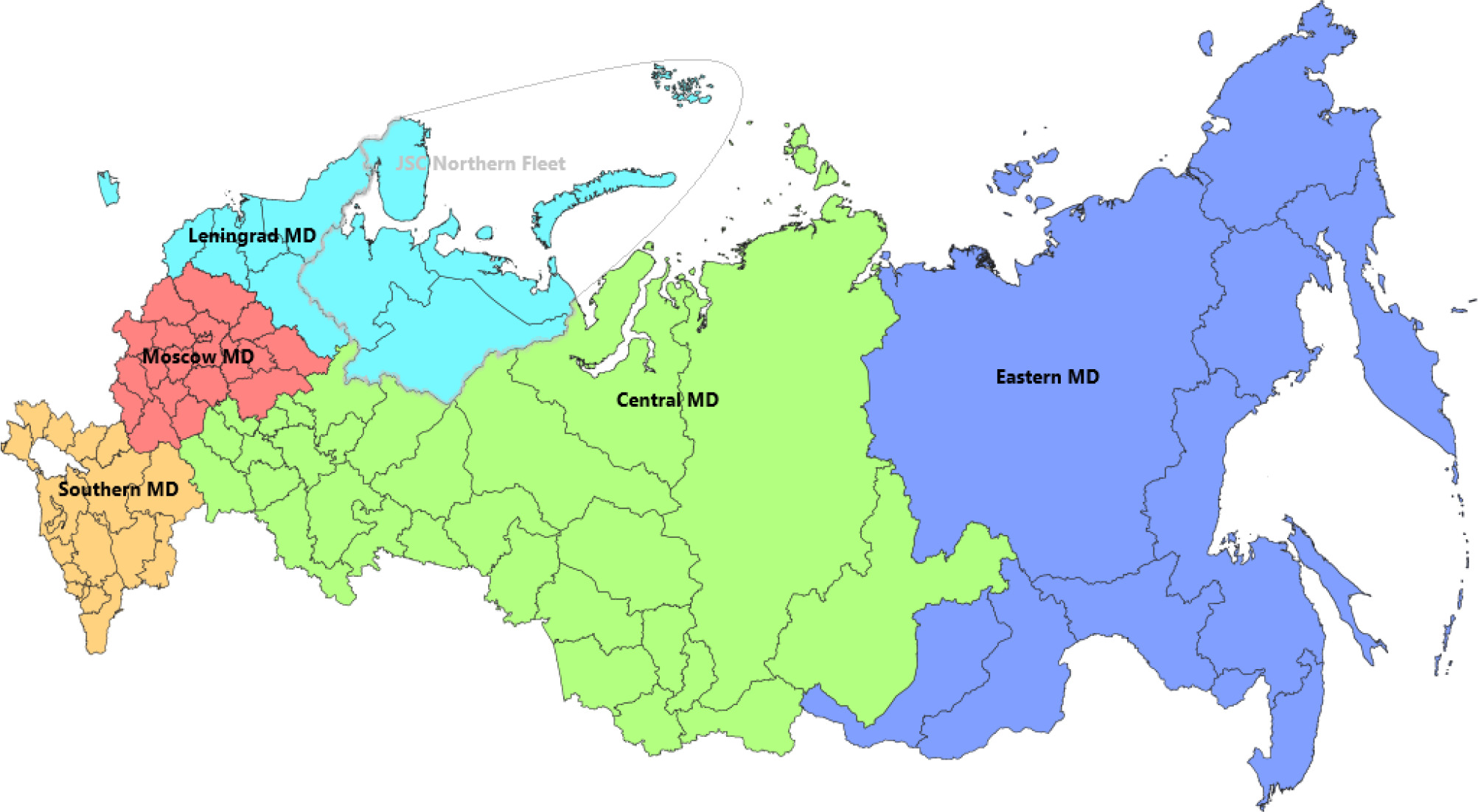
The western MD is split, whereas the Northern Fleet maintains its district-like status (Joint Strategic Command Northern Fleet, JSC). Marine Corps brigades throughout Russia’s western frontier shall be upgraded to divisions. Whether these plans entirely realise, the number of Russian forces along its northwestern border may rise to 66,000 (Panschin, 2024, pp. 40–45). Approximately, this would triple their manning. The vilest scenarios speak of a hundred thousand soldiers to be dislocated east of Finland, although these are highly speculative figures. Whether these function as click-bates or later-to-concretise estimates, it requires distinct inquiries. Generally, Ukraine’s June 2025 strikes as far as to Olenya, an air base packed with strategic bombers TU-22M3 and TU-95MS, in the Kola Peninsula (Humpert, 2025), question the shrewdness to concentrate massive corps anywhere. Of course, warfare during the era of mini-sized but fatal drones demands research of its own.
The eastern and northernmost regions of Finland (and of Norway)—consisting much of the Arctic—border the key locations for Russia’s strategic submarines, equipped with most of the Russian nuclear warheads on their long-haul missiles. In addition, the least trajectory for any hypothetical projectile foray from/to the United States crosses the North Pole. Hence, the area is essential for early warning and defence systems (Baev, 2018, pp. 410, 412–414, 420). Certain analysts even call the Russian Arctic between Novaya Zemlya and the Kola Peninsula as vital for the military and/or security prospects (Godzimirski and Sergunin, 2020, p. 40). While the Finnish and Swedish then-predictable memberships would turn the Baltic Sea into NATO’s internal waters, the importance of the Arctic further increases. For example, in early November 2025, evidence of this trend was related to arms development; the new Russian nuclear-propelled torpedo, Poseidon, and the fresh nuclear-powered cruise missile, Burevestnik, underwent testing in the Polar region. Also, in response to the US decision to restart nuclear trials, President Putin ordered foreign and defence ministries, security and other services to “gather further information on this question, to analyse it…, and to bring about coordinated proposals on plausible iteration of the work to launch nuclear arms testing” (Putin, 2025). Interestingly, Putin here employs both rationalisation and authorisation by traditions. Firstly, he requires more data on the issue. Next, according to the Russian president, the United States has readily relinquished the arms control agreements; thus, if Washington DC shall renounce the moratorium of nuclear tests, it would constitute “an entirely logical step to ruin the system of global strategic stability” (Putin, 2025). This highly timely topic, however, merits an investigation of its own; especially, since the situation appears a reflection of that of 2019. What is foreseeable is that the importance of test ranges, such as Novaya Zemlya, intensifies. For its part, the heightening contest prompts militarisation of the Russian regions by the Finnish boundary—and perhaps, Putin’s discourse.
Conclusions
It is evident that the Russian president is a capable orator. He is at ease navigating from daily to illustrious lexicon, and thus, reaches various strata of the population. His discursive stratagems seem to have been established during the last 10 years, amidst and prompted by the rising tensions between the eastern and western hemispheres. This concretises in Putin’s present way to combine both ‘I’ and ‘we/our’ to factually represent the entire Russia under threat. The development in Ukraine from 2014 has further toughened his tone, let alone the launch of the SMO in Ukraine in late February 2022. For instance, the heightened confrontation is tangible in Putin’s absolute qualification about NATO’s status as a mere tool for the US interests, such as the adverbs “solely” and “completely.” According to Putin’s discourse, this legitimises Moscow’s equal endeavours in the High North.
Nonetheless, in the minds of Moscow, the menace does not materialise in NATO. This is apparent in the cases of Finland’s and Sweden’s corresponding bids in 2022–2023. While Finland after 80 years of military non-alignment policy applied for NATO, Putin rather bemoaned the loss of good neighbourly relations which through decades have benefited both sides. That is, he employed authorisation by traditions to further his aims. According to the Russian leader, the decisions are “erroneous;” both to the Finns and to Russia’s partners Putin stressed that there is nothing to jeopardise Finland’s nor Sweden’s calm. He underscored that there are no disputes of any kind with Helsinki and Stockholm, unlike with Kyiv. Apart from continuing his authorisation by traditions and customs, by this argument, Putin delivers an implicit moral evaluation; in contrast to the Ukrainians, the Finns and Swedes sustain neutral stances on their Russian-speaking neighbours. Regarding the SMO, that is, Russia’s onslaught against Ukraine, Putin offered an analogous explanation to his Finnish counterpart, Sauli Niinistö. It was duly undertaken to “defend Donbas.” Putin even mitigated the entire conflict; it was merely “an internal crisis.” As the material regarding Kyiv’s policy here is minimal, I exhort my colleagues to deepen these preliminary outcomes, and especially, to juxtapose Putin’s idiom on Ukraine with that on Finland (or Sweden).
Truly, Putin perceives the Finns as a lured nation; in other words, he implicitly blames foreign powers for an intrigue to “drag” the Nordic countries in NATO. Here, the main audience consists of domestic media and officials as well as those of Russia’s partners in the East. Therefore, the Russian president mitigates the clear contradiction of Russians fighting to deter NATO from Ukraine but soon having the alliance next to their backyards. Whether Putin covertly refers to the too frequent opinion surveys in Finland which attested a triple surge in NATO’s popularity throughout spring 2022 (i.e. applies rationalisation) is a fascinating interpretation. Indeed, less than a half year prior, those in favour comprised only 26%, while 40% rejected the alliance; still in January 2022, only 28% backed Finland’s NATO membership. I invite my fellow scholars to explore this intriguing turn, particularly the situation in January–February 2022. For example, the correlation between the share of those who believed Russia would invade Ukraine, and of those who voiced support for NATO (and vice versa) might prove illuminating. Not least, because Putin’s notion of a deceived nation probably alludes to the exemption of referendum. If this is the case, Moscow uses an inverse rationalisation; since the citizens never had a democratic say, there are no true figures for or against. On second thought, Putin’s knowledge on Finland’s currents may just entail nostalgic memories from the YYA era and imagined elements. However, the explanation models do not necessarily exclude each other and inherently highlight the need for farther inquiries. Obviously, after Russia launched its invasion, a vast reassessment took place among the folks. Ultimately, in May 2022, Finland opted for the historical turn and initiated the process.
More than once Putin reiterates his acceptance; he even exhorts the Finns to proceed with the bid. It is not NATO that concerns Moscow, nor the joint total of Finnish and Swedish combatants and military assets. Putin correctly anticipated the future moves, that is, Finland’s defence collaboration with the United States. Although, as initially there was no concrete data, he in part took advantage of storytelling. Namely, the talks between Washington DC and Helsinki commenced in autumn 2022, ending in the signing of DCA a year later. In Putin’s idiom, the American factor globally appears by 2015, and in relation to the Nordics, from autumn 2019. While the timing is relatively well explored in the former context, regarding the latter, I propose to extend my preliminary findings. This would shed more light on two intriguing notions. How did the US pursuits shape the bilateral talks between Moscow and Helsinki in the late 2010s? Another probe could juxtapose the Russian (and Finnish?) views on the US’ projectile tests in 2019 with those in our very days in late 2025.
During the research period of 2022–2023, Putin did not hide his revulsion of the estimated US military installations and units in Finland, next to Russia. NATO only serves as a disguise. If one considers that in 2019 Putin speculated the American missiles to be dislocated in such allied states as Poland and Romania, it makes sense whether the Russian president here clandestinely projected similar steps in the cases of new NATO members Finland and Sweden. This is a topic for later investigations. Overall, Putin sharply legitimised Moscow’s strengthening presence in the Arctic by alluding to the future. To counter the risks, Russia upgrades and increases its troops by its northwestern border, perhaps up to 100,000 soldiers. As the Baltic Sea would transform into a NATO–US lake, and as Moscow’s core strategic nuclear assets are situated in and near the Kola Peninsula in the High North, Putin envisaged the conflict to intensify. His discourse on the Finns and Swedes, instead, carried on with a tender tone, to urge them not to deepen bilateral military collaboration with the United States.