

Introduction
In the digital era alongside the rapid development of disruptive technologies, digital transformation in higher education has become an objective necessity. Educational systems worldwide are undergoing comprehensive structural changes driven by artificial intelligence (AI), big data, and machine learning. Within the Vietnamese national education system, the application of information technology in teaching is considered a focal strategy to modernise education and meet human resource training standards in the new era. The emergence of generative AI tools, smart learning management systems (LMS), and simulation technologies not only alters the delivery of information but also directly intervenes in instructional designs, assessment methods, and academic interactions.
Among the courses in the higher education curriculum, National Defense and Security Education (NDSE) is a mandatory module with highly specific characteristics. The structure of this course requires a strict integration of political theory, military art, and practical field skills. The core objective of the course extends beyond imparting knowledge to fostering civic consciousness, critical thinking, and the capability to respond to both traditional and non-traditional security threats. However, the traditional pedagogical model currently faces limitations concerning physical space, a lack of synchronised training equipment, and high operational costs of field training grounds.
Traditional military theory instruction relies heavily on lecturing techniques, which can easily lead to student passivity and diminished concentration. Furthermore, the unique nature of the NDSE module necessitates significant time devoted to field practice, such as marksmanship or grenade throwing techniques. These activities are directly governed by weather conditions and inherently carry safety risks during training. Moreover, the costs associated with maintaining training grounds, ammunition, and consumable supplies impose a substantial financial burden on educational institutions. In this context, the integration of AI and virtual reality (VR) simulation is an essential technological solution capable of simultaneously addressing the challenges of safety, cost-efficiency, and visual engagement. Simulation technology enables the creation of training environments that closely mimic actual combat conditions, allowing learners to repeatedly practice complex skills without consuming real materials, thereby optimising training resources.
Integrating AI and three-dimensional (3D) simulation technologies into NDSE teaching provides a novel approach to overcoming these barriers. AI technology facilitates the establishment of virtual shooting ranges, automates the evaluation of marksmanship results, and personalises the theoretical learning pathways for individual students. Although the theoretical benefits of AI in education have been validated in numerous international studies, empirical evidence regarding the effectiveness of these technologies within the specific context of military training in Vietnam remains sparse. The majority of current studies predominantly describe the status quo of application of basic information technology (IT) or assess it from an administrative management perspective, lacking quantitative analyses that directly measure the impact of technological and psychological variables on educational outcomes.
Recognising this research gap, the present article focuses on analysing and measuring the interactions among technological platforms, organisational conditions, and learner competencies regarding course effectiveness. By addressing this gap, this study offers dual contributions. Theoretically, it extends the technology acceptance literature by examining a mandatory, highly regulated, and hierarchical military training context, offering novel insights into how institutionalised settings alter standard adoption behaviours. Practically, the findings provide actionable empirical evidence for educational policymakers in Vietnam to optimise digital transformation strategies, specifically through targeted synchronous infrastructure investments and pedagogical adaptations in defence education.
Literature review
Artificial intelligence is fundamentally reshaping the global educational ecosystem by enabling personalised learning pathways, intelligent tutoring systems, and automated assessment tools (Chen et al., 2020; Holmes et al., 2019). The integration of AI-supported adaptive learning platforms not only enhances instructional efficiency but also alleviates the administrative burden on educators. However, systematic reviews indicate that AI adoption in education remains largely spontaneous, facing significant challenges regarding users’ technical competencies, infrastructural deficits, and concerns over ethics and algorithmic bias (Chiu et al., 2023; Zawacki-Richter et al., 2019).
In the context of Vietnam, the application of AI in education aligns with the National Digital Transformation Program to 2025, with an orientation towards 2030 (Government of Vietnam, 2020). Despite supportive macro-level policies, practical implementation across Vietnamese universities encounters notable barriers. Recent evidence suggests that technology acceptance among both faculty and students is primarily driven by the performance expectancy of surface-level AI tools, such as using ChatGPT for translation or basic searches (Hung et al., 2026). Meanwhile, the deep integration of AI into specialised pedagogical methods remains constrained by a lack of synchronised infrastructure and formal training programs (Perez, 2024; Pham and Ho, 2020).
National Defense and Security Education is a mandatory module in Vietnamese higher education institutions. This course is highly specific, requiring a strict combination of political theory, military art, and practical field skills (Trinh, 2023). To address the current limitations regarding training space and operational costs, domestic studies have emphasised the urgency of applying simulation technology and AI within NDSE, such as deploying “virtual shooting ranges” or intelligent digitised learning systems (Bui, 2023). Nevertheless, digital transformation within this specific discipline is still in its infancy, and the technological proficiency of the teaching staff remains relatively limited (Ngo et al., 2026).
While the current systematic reviews indicate that educational AI research predominantly targets voluntary or standard academic domains, such as Science, Technology, Engineering, and Mathematics (STEM) and English as a Foreign Language (EFL) (Pham and Dang, 2025; Pham and Le, 2024), its application in mandatory, regulated military training in developing countries such as Vietnam remains critically underexplored. In the broader international discourse, contemporary studies collectively emphasise that immersive technologies are vital for bridging the gap between theoretical knowledge and practical skill execution in high-risk environments. For instance, recent evidence synthesises that VR- and AI-driven simulations act as transformative tools for combat readiness by enabling the safe repetition of tactical manoeuvres, optimising training transfer, and replicating high-stress environments without live-fire risks (Tambre, 2025; Tanwar et al., 2024). However, studies employing technology acceptance models to evaluate AI typically measure outcomes in subjects where the abstraction of tactical manoeuvring and the demand for fine motor skills are less prominent.
This study addresses this research gap by empirically evaluating the effectiveness of integrating AI and specific simulation technologies into the NDSE curriculum. By utilising structural equation modelling (SEM) to assess constructs derived from the foundational technology acceptance theory (Venkatesh et al., 2003)—including AI readiness (AIR), performance expectancy (PE), effort expectancy (EE), and facilitating conditions (FC)—this research provides critical empirical evidence to assist policymakers in upgrading pedagogical strategies for national defence education in Vietnam.
Recent international literature highlights that VR- and AI-driven simulations are transformative for combat readiness, as they enable the safe repetition of tactical manoeuvres and optimise training transfer (Tambre, 2025). Furthermore, immersive technologies, such as AR and VR, have proved to significantly enhance tactical and technical training efficacy by replicating high-stress environments without live-fire risks (Tanwar et al., 2024).
Theoretical framework and research model
Theoretical background: An adapted unified theory of acceptance and use of technology (UTAUT)-based research model
The adoption and application of new technologies in this study are examined through an adapted research model based on UTAUT (Venkatesh et al., 2003). The original UTAUT model was deliberately selected as the foundational framework over its later extensions (such as UTAUT2) because the latter primarily focuses on voluntary consumer contexts, incorporating variables such as price value and hedonic motivation, which are less applicable to a compulsory higher education module. In contrast, the original UTAUT robustly captures the core functional and organisational drivers of technology acceptance. Certain original UTAUT constructs, such as social influence, were excluded because NDSE is a mandatory, highly regulated module where technology usage is driven by the institutional curriculum rather than peer influence. Behavioural intention was also omitted, as the objective of this study is to measure the post-adoption perceived learning effectiveness rather than the intention to use. Furthermore, AI readiness was incorporated to account for the specific technical baseline required to interact with AI and VR systems.
Additionally, cognitive load theory (CLT) is applied in this study not as a directly measured psychometric construct but as a robust interpretive framework. While the psychometric variables do not directly quantify cognitive load, the principles of CLT elucidate how high-performance expectancy and facilitating conditions potentially reduce extraneous load during complex tactical simulations, thereby optimising the learners’ absorptive capacity.
Guided by the adapted UTAUT model, this study addresses two central research questions: (1) How do technological factors (performance expectancy and effort expectancy) and organisational contexts (facilitating conditions) impact students’ perceived learning effectiveness in NDSE? (2) Does students’ AI readiness show a significant independent association with learning outcomes in this rigid training environment?
Research model and hypotheses
Inheriting foundational theoretical models and based on the specificities of the NDSE course, this study establishes four independent variables capable of affecting the dependent variable, which is the perceived learning effectiveness of students.
First, facilitating conditions measures the extent to which the educational institution provides hardware infrastructure, Internet bandwidth, VR equipment, and technical support services. In higher education, technological infrastructure is an indispensable prerequisite for deploying smart learning platforms. Thus, the following hypothesis is proposed:
Hypothesis H1: Facilitating conditions have a positive impact on the learning effectiveness of NDSE course.
Second, AI readiness reflects students’ computer literacy, adaptability, and information security capabilities. Students with high digital proficiency can minimise cognitive load when interacting with new interfaces, enabling them to focus better on professional content. The following hypothesis is proposed:
Hypothesis H2: Students’ AI readiness has a positive impact on the learning effectiveness of the NDSE course.
Third, performance expectancy assesses the degree to which students believe that AI tools help to improve their ability to memorise tactics, reduce search time, and enhance academic performance. This is the core variable determining the motivation to use technology across behavioural models. The hypothesis is formulated as follows:
Hypothesis H3: Performance expectancy has a positive impact on the learning effectiveness of the NDSE course.
Fourth, effort expectancy reflects the user-friendliness of technological interface, requiring minimal time for learners to become accustomed to the system. Ease of use serves to eliminate initial technical barriers. The corresponding hypothesis is as follows:
Hypothesis H4: Effort expectancy has a positive impact on the learning effectiveness of the NDSE course.
Methods
Research design and measurement instruments
Items of the original questionnaire derived from foundational frameworks (Davis, 1989; Venkatesh et al., 2003) were subjected to a rigorous forward–backward translation process by bilingual experts in educational sciences to ensure semantic equivalence and cultural appropriateness for Vietnamese students. A pilot test was conducted with thirty students prior to the main survey. Furthermore, specific contextual adjustments were applied to the AI readiness scale. Because the original instrument by Hung et al. (2026) was designed for an instructor sample, the measurement items were systematically adapted to suit the student population. This adaptation involved modifying pedagogical terminologies to reflect learning-oriented contexts—for instance, rephrasing terms related to “instructional delivery” or “teaching tasks” into “academic study” and “learning activities.” The core theoretical integrity of the AI readiness construct was strictly preserved and its reliability was subsequently confirmed during the pilot test. During this phase, the effort expectancy scale, which originally contained five items, was refined; one item was removed due to a factor loading below the 0.60 threshold, thereby maximising the construct’s internal consistency for the final instrument.
The study utilised a quantitative approach with a cross-sectional survey design. Primary data was collected using a structured questionnaire. The measurement instrument comprised twenty-four observable variables categorised into five scales, adapted and modified from previous studies to suit the context of national defence education in Vietnam. All observable variables were evaluated using a 5-point Likert scale (ranging from 1: strongly disagree to 5: strongly agree). Construct definitions and measurement sources in shown in Table 1.
Table 1
Construct definitions and measurement sources. Notes: NDSE: National Defense and Security Education; AI: artificial intelligence; VR: virtual reality.
| Construct | Items | Description of measurement items | Main sources (adaptedfrom following references) |
|---|---|---|---|
| Facilitating conditions (FC) | 5 | Availability of hardware, stable network bandwidth, VR equipment, and technical support provided by the institution. | Venkatesh et al., 2003 |
| AI readiness (AIR) | 5 | Students’ baseline computer literacy, adaptability to digital platforms, and fundamental information security awareness. | Hung et al., 2026 |
| Performance expectancy (PE) | 5 | The degree to which AI and VR tools are perceived to enhance tactical memorisation, reduce information search time, and improve academic performance. | Davis 1989; Venkatesh et al., 2003 |
| Effort expectancy (EE) | 4 | The perceived user-friendliness of the technological interface and the minimal effort required to navigate simulation systems. | Venkatesh et al.,2003 |
| Learning effectiveness (LE) | 5 | Students’ self-reported enhancement in situational awareness, tactical understanding, and the overall engagement in the NDSE module. | Alam et al., 2026 |
The digital tools integrated into the evaluated NDSE module primarily consist of VR-based tactical simulation systems (e.g., virtual battlespace environments) and AI-automated marksmanship evaluators. Students engaged with these tools during weekly 45-minute practical sessions, utilising head-mounted VR displays for situational awareness training and laser-integrated training firearms for practice of shooting. The pedagogical objective of these tools was to provide safe, repeatable, and cost-effective experiential learning environments prior to live-fire exercises.
Ethical statement: As an observational survey study involving adult students and carrying no more than minimal risk, formal ethical approval from an Institutional Review Board (IRB) was exempted in accordance with the institutional guidelines. Nevertheless, the research was conducted in strict adherence to international ethical standards for research involving human subjects. Prior to data collection, all participants were fully informed about the study’s pedagogical objectives, the voluntary nature of their participation, and their absolute right to withdraw at any time without facing any academic penalty. Explicit informed consent was obtained electronically from every participant before they were granted access to the questionnaire. To ensure strict data privacy and confidentiality, no personally identifiable information was recorded, and all responses were completely anonymised prior to statistical analysis.
Sample and data collection: A purposive sampling technique was employed. The survey was administered to students across three diverse higher education institutions in Ho Chi Minh City, South Vietnam, during March and April 2026. Specifically, the sample comprised 112 students from Ho Chi Minh City University of Education, ninety-three students from Sai Gon University, and ninety-five students from Van Lang University. While these institutions shared a standardised national defence curriculum, variations in their localised technical infrastructure could potentially influence the students’ perception of facilitating conditions. Initially, 360 students who had completed the NDSE module integrated with VR-based tactical simulations and AI-automated marksmanship evaluators were approached, and questionnaires were distributed online via Google Forms within 2 weeks after the students completed the course. Throughout the semester, the students had attended a total of eight 45-minute practical sessions. After the data collection period, 318 responses were received, yielding a high response rate of 88.3%. Following data cleaning—which involved removing eighteen responses due to incompleteness or exhibiting straight-lining patterns—the valid sample size retained for formal analysis was N = 300. This final sample size adequately satisfied the recommended threshold for SEM, which suggested a minimum of ten observations per indicator variable. Given the twenty-four observable items in this study, the retained sample size ensured robust statistical power for the maximum likelihood (ML) estimation. During the pilot test phase (N = 30), the effort expectancy scale was refined; one item (EE5) was removed due to a factor loading below the 0.60 threshold. While this early removal represents a minor measurement limitation, the retained four-item construct demonstrated strong internal consistency in the main sample.
Data analysis techniques: The data was coded and analysed using the jamovi statistical software integrated with the SEMLj module (The jamovi project, 2024). The analytical procedure comprised three phases: (1) descriptive statistics for demographic characteristics and observable variables; (2) evaluation of the measurement model was conducted based on standard multivariate data analysis criteria (Hair et al., 2014), utilising Cronbach’s alpha, composite reliability (CR), and average variance extracted (AVE) to confirm convergent validity, along with the Heterotrait–Monotrait ratio (HTMT) to establish discriminant validity; and (3) SEM analysis to calculate path coefficients (β), p-values, and the coefficient of determination (R2) to test research hypotheses. The structural model and path coefficients were estimated using the maximum likelihood method. To ensure absolute methodological rigour, HTMT for discriminant validity was manually calculated directly from the item-level Pearson correlation matrix of the observed variables, strictly adhering to the fundamental methodology proposed by Henseler et al. (2015). The structural model and path coefficients were estimated using the maximum likelihood method. Although the data was collected using 5-point Likert scales, estimation of maximum likelihood was considered robust and appropriate, given that the univariate skewness and kurtosis of all observed variables accrued strictly within the acceptable threshold of -2–+2. Specifically, the skewness values ranged from -0.431 to -0.054, and kurtosis values ranged from -0.457 to 0.663, confirming substantial adherence to normal distribution assumptions required for parametric testing.
Results
Demographic characteristics of the sample (Table 2)
Table 2
Demographic characteristics of the sample (N = 300).
| Characteristics | Category | Frequency (N) | Percentage (%) |
|---|---|---|---|
| Gender | Male | 139 | 46.3 |
| Female | 161 | 53.7 | |
| Academic year | 1st year | 85 | 28.3 |
| 2nd year | 93 | 31.0 | |
| 3rd year | 54 | 18.0 | |
| 4th year | 68 | 22.7 | |
| Region | Urban | 179 | 59.7 |
| Rural | 121 | 40.3 |
The gender distribution consisted of 139 males (46.3%) and 161 females (53.7%). The academic year distribution was concentrated among 1st-year and 2nd-year students (accounting for 59.3%), accurately reflecting the typical enrollment period for the NDSE course at universities. Regarding residential areas, 59.7% of the students belonged to urban regions and 40.3% to rural areas.
Descriptive statistics were examined at both individual item level and construct level to provide a transparent overview of the data. At the item level (observed variables), the mean scores ranged from 3.97 (FC1) to 4.02 (FC3 and LE4), with standard deviations (SD) strictly ranging between 0.620 and 0.674. Notably, the minimum and maximum reported values for all twenty-four individual measurement items were consistently 2.00 and 5.00, respectively, indicating that no respondents selected the option (1), that is, “strongly disagree.”
At the construct level (latent variables computed as composite scores), as presented in Table 3, the aggregated mean scores ranged narrowly from 3.991 (AI readiness) to 4.001 (facilitating conditions), reflecting a consistently positive evaluation across all theoretical factors.
Table 3
Descriptive statistics of constructs.
The absence of lowest-tier responses and high mean scores across all items are reasonably attributed to the striking contrast between the novel simulation tools and the traditional lecture-heavy military training methods. Students generally exhibited high enthusiasm and positive reception towards the interactive nature of the technologies, leading to uniformly favourable evaluations.
Measurement model evaluation (outer model)
Common method variance (CMV) assessment: Given the self-reported nature of the cross-sectional data, Harman’s single-factor test was conducted to assess potential common method bias. The unrotated principal axis factoring revealed that the single largest factor accounted for only 36.4% of the total variance, well below the critical threshold of 50%. This provides preliminary statistical evidence that common method bias may not be a severe issue in this study. However, given the self-reported nature of the data, the potential presence of CMV cannot be entirely ruled out definitively.
Reliability and convergent validity: Table 4 presents the results of the scale quality assessment. All constructs achieved excellent Cronbach’s alpha coefficients, ranging from 0.921 to 0.930. The factor loadings of all observable variables exceeded the 0.7 threshold, ranging from 0.813 to 0.881 with a significance level of p < 0.001. Composite reliability varied between 0.921 and 0.930, exceeding the standard criterion of 0.7. The AVE for all factors was more than 0.5, ranging from 0.700 to 0.745 (Fornell and Larcker, 1981). These indicators confirmed that the scales strictly adhered to the criteria for reliability and convergent validity.
Table 4
Results of reliability, convergent validity, and item-level factor loadings.
Discriminant validity assessment: Given the conceptual proximity between PE and LE, further empirical differentiation was established. The mean inter-item correlation within the PE construct (0.728) and within the LE construct (0.702) significantly exceeded the mean cross-construct correlation between PE and LE items (0.466). Furthermore, the HTMT value between PE and LE was 0.653, well below the stringent 0.85 threshold, mathematically confirming that students perceived and evaluated these two constructs as distinct concepts (Table 5). To further address the conceptual proximity between PE and LE, a competing measurement model analysis was conducted. We compared the hypothesised two-factor model (PE and LE as distinct constructs) against a one-factor model (all PE and LE items constrained to load on a single factor). The two-factor model demonstrated a vastly superior fit (χ2df), compared to the one-factor model (χ2 = 598.19, df = 35). The Chi-square (χ2) difference was highly significant (Δχ2 = 553.64, Δdf = 1, p < 0.001), providing definitive empirical evidence that students perceived PE and LE as distinct constructs despite their theoretical adjacency.
Table 5
Heterotrai–Monotrait ratio matrix for discriminant validity assessment.
| Construct | FC | AIR | PE | EE | LE |
|---|---|---|---|---|---|
| Facilitating conditions (FC) | - | ||||
| AI readiness (AIR) | 0.316 | - | |||
| Performance expectancy (PE) | 0.433 | 0.341 | - | ||
| Effort expectancy (EE) | 0.213 | 0.528 | 0.381 | - | |
| Learning effectiveness (LE) | 0.571 | 0.385 | 0.653 | 0.436 | - |
To further substantiate discriminant validity, the Fornell–Larcker criterion was applied. As presented in Table 6, the square root of AVE for each construct, shown on the diagonal, is strictly greater than its highest correlation with any other construct in the model. This confirms that each latent variable shares more variance with its own specific measurement items than with other theoretical constructs.
Table 6
Fornell–Larcker criterion matrix. Note: Bold values on the diagonal represent the square root of average variance extracted (AVE).
Model fit: The statistical indicators derived from the jamovi software suggest that the measurement model demonstrates a favourable approximate fit with the sample data: χ2(242) = 304.00, p = 0.004; the comparative fit index (CFI) reached 0.989; and the Tucker–Lewis Index (TLI) reached 0.988. The root mean square error of approximation (RMSEA) was 0.029, and the standardised root mean square residual (SRMR) was 0.030. It should be noted that the reported 242 degrees of freedom (DoF) matched the confirmatory measurement model. Because all the four correlated predictors directly explained the same single outcome variable, the structural part of the latent-variable model was saturated; consequently, the fit indices for the measurement model and the full structural model were identical.
Structural equation modelling and hypothesis testing
The structural model analysis provides results regarding the causal relationships among variables. The coefficient of determination (R2) of the model was 0.563, indicating that the independent variables (FC, AIR, PE, and EE) accounted for 56.3% of the variance in the dependent variable, LE.
To examine the causal relationships within the analytical framework, the study conducted an SEM analysis. The findings were visualised through a path diagram displaying the standardised impact coefficients (β) and the explained variance (R2) of the dependent variable. The detailed impact network model is presented in Figure 1.
Figure 1
Results of the structural equation modelling (SEM) analysis. Note: The explained variance R2 for learning effectiveness (LE) is 0.563.
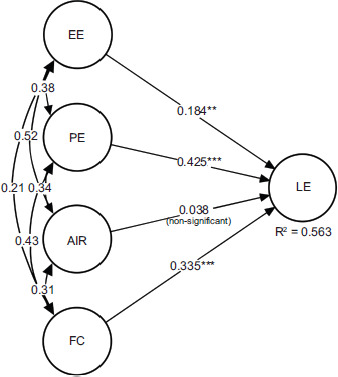
Detailed hypothesis testing results are presented in Table 7.
Table 7
Path analysis and hypothesis testing results. Note: The unstandardised estimates (B) are reported alongside their respective standard errors (S.E.), Z-values, and p-values. The standardised estimates (Std. β) are reported with their corresponding 95% confidence intervals (95% CI).
The data shown in Table 7 confirms that three out of the four hypotheses are supported. Performance expectancy (PE) demonstrated the most substantial impact on course learning effectiveness (β = 0.425; p < 0.001). Facilitating conditions recorded the second most critical impact (β = 0.335; p < 0.001). Effort expectancy exhibited a lower, yet positive impact (β = 0.184; p = 0.002). In contrast to initial expectations, AI readiness achieved an impact coefficient of only β = 0.038 with p = 0.527, leading to the rejection of hypothesis H2.
Discussion
The results obtained from the SEM model offer explicit empirical rationale regarding the mechanisms shaping educational effectiveness when digital technologies are applied to the NDSE module.
Firstly, the dominant role of performance expectancy: The β coefficient of 0.425, ranking highest in the model, affirms that the practicality of the tools is the most pivotal value for students. Within military training environments, theories regarding combat tactics and weaponry techniques often possess high abstraction, while field practice time is limited. When AI platforms and 3D/VR simulations are integrated, they comprehensively resolve spatial barriers, enabling students to visually observe equipment models and experience simulated combat scenarios. The transformation of knowledge from text-based to interactive formats strongly acts upon the germane load, facilitating memory retention and decision-making capabilities. This finding aligns perfectly with previous studies (e.g., Alam et al., 2026; Yaseen et al., 2025), reinforcing that the value of educational technology lies not merely in the modernity of the equipment but in the extent to which the equipment is compatible with and enhances the subject’s methodology.
Secondly, the dependency on facilitating conditions: With an impact level of NDSE β = 0.335, physical infrastructure acts as a foundational requirement. The specialised nature of military simulation technology requires high-configuration hardware, stable network bandwidth, and dedicated smart classrooms. This result accurately reflects the fragmented state of infrastructure across Vietnamese universities. Signal interruptions or a shortage of practical equipment directly inflate the extraneous load, causing interference in students’ cognitive processes. This underscores the urgent necessity of maintaining continuous technical support from educational institutions.
Thirdly, the contextual shift regarding the digital literacy barrier (AI readiness): The lack of statistical support for hypothesis H2 (Std. β = 0.038; p = 0.495) necessitates a nuanced interpretation. Pearson correlation analysis inherently indicates a positive zero-order association between AI readiness and perceived learning effectiveness; however, this direct structural relationship becomes non-significant when analysed simultaneously with other predictors in the model. This implies that baseline digital literacy does not show a significant independent association with learning outcomes in this specific context. Future research should investigate whether pragmatic functionality (performance expectancy) acts as a mediating mechanism between students’ digital readiness and their learning outcomes.
Fourthly, the secondary yet statistically significant effect of effort expectancy on learning effectiveness (β = 0.184; p = 0.001) necessitates further analytical contextualisation. While positive, its magnitude is noticeably lower than that of performance expectancy. This variance can be elucidated through the concept of technological maturation among contemporary student cohorts. Because digital proficiency now constitutes a universal baseline, the navigational simplicity of a user interface transitions from being a primary motivational driver to a fundamental hygiene factor. Learners no longer perceive operational simplicity as an added educational value; rather, it operates as an intrinsic expectation. If a simulation platform or an adaptive learning system proves overly complex, it inevitably inflates the extraneous cognitive load and impedes knowledge acquisition (Alam et al., 2026). However, an intuitive interface alone does not proportionately amplify the germane load unless the embedded content delivers tangible practical utility. This finding refines the traditional technology acceptance model, indicating that in highly specialised instructional domains such as military education, pragmatic functionality strictly supersedes navigational aesthetics.
A critical theoretical contribution of this study is the contextualisation of technology acceptance within a mandatory, highly regulated, and hierarchical training environment. Unlike voluntary educational settings, such as elective STEM courses or self-directed language learning, where hedonic motivation and peer influence significantly drive adoption, the NDSE module enforces technology usage through strict curriculum mandates. In this rigid context, the traditional drivers of technology acceptance undergo a structural shift. Navigational ease, represented by effort expectancy, becomes a baseline expectation rather than a strong motivator, while performance expectancy overwhelmingly dictates learning effectiveness because students are intrinsically focused on the pragmatic utility of the tools to meet rigorous institutional assessment criteria. This finding enriches the broader UTAUT literature by demonstrating that hierarchical educational environments filter out secondary motivations, distilling technology acceptance down to its pure utilitarian value and the necessity of robust institutional support, operationalised as facilitating conditions.
Furthermore, the empirical validation of the integrated model illuminates a structural shift in the pedagogical architecture of NDSE. Traditionally characterised by instructor-centric methodologies, military theory training inherently risks inducing cognitive passivity. The introduction of AI, particularly through adaptive learning technologies and personalised feedback mechanisms, significantly transforms this conventional instructional approach (Yaseen et al., 2025). By automating routine assessments and generating real-time, data-driven insights regarding a student’s tactical decision-making processes, AI systems afford instructors the capacity to tailor instructional interventions. This shifts the educational locus from a standardised dissemination of military doctrine to a highly individualised, competency-based framework. Students transition from passive recipients of theoretical constructs to active participants in simulated operational environments, thereby fostering higher-order cognitive skills necessary for security analysis.
Moreover, the integration of advanced computational tools into defence education warrants a critical evaluation regarding algorithmic reliance. While virtual reality and intelligent tutoring systems undeniably enhance situational awareness and tactical retention (Wang et al., 2020), their implementation must be meticulously calibrated to prevent the erosion of human intuition. In defence and security scenarios, critical decision-making under physiological stress remains an irreplaceable competency. The effectiveness of AI should not be construed as a complete substitution for experiential field training but rather as a sophisticated cognitive scaffold. A strategic equilibrium is required where AI acts as a supplementary layer, augmenting rather than supplanting the human-centric aspects of military command and ethical judgement. Ultimately, sustaining the long-term efficacy of digital transformation in this discipline depends on harmonising technological affordances with the rigorous psychological demands of national security training.
The findings of this study resonate with broader trends identified in recent systematic reviews of AI in higher education, which highlight the transformative potential of AI and large language models across diverse academic disciplines (Alqahtani et al., 2023; Gera and Chadha, 2021). Specifically, the positive impact of AI integration on student engagement and performance expectancy in NDSE can be further explained through the lens of cognitive load theory. Similar to observations in other learning environments, AI-assisted tools and simulation technologies in military training help to optimise instructional delivery and manage the intrinsic complexity of the subject, thereby enhancing the overall learning outcomes without overwhelming the students (Alam et al., 2026). Furthermore, these results provide empirical evidence to support the ongoing digital transformation within the Vietnamese educational system. While previous research in Vietnam has primarily focused on proposing adaptive educational models for general education (Bui et al., 2022) or evaluating digital innovations in high school management and assessment (Luong, 2024), the current study demonstrates that such technological advancements are equally viable and necessary in highly specialised and structurally rigid domains, such as national defence education.
Conclusions
The study provides empirical evidence regarding the impact of digital technology and AI on students’ self-reported perceived learning effectiveness in the NDSE course in Vietnamese higher education. Through SEM analysis on a sample of 300 students, the research concludes that the performance expectancy of the tools and the infrastructure conditions provided by the institution are the critical factors of the success of this modern learning approach. Furthermore, students’ baseline technological operational level does not serve as a primary barrier affecting their perceived learning effectiveness.
Derived from the research findings, several policy implications are proposed for national defence education centres and higher education institutions:
Synchronous infrastructure investment strategy: Based on the profound impact of facilitating conditions, institutions must prioritise budget allocations to construct tactical simulation classrooms, establish virtual shooting ranges, and upgrade LMS operations. Investments must ensure synchronicity between hardware and software to optimise students’ interactive experiences.
Optimisation of the pedagogical interface design: Acknowledging the roles of performance expectancy and effort expectancy, digital learning platforms should be designed with a focus on visual intuitiveness, minimising complex login procedures or technical operations. Generative AI content must be rigorously subjected to content validation and doctrinal expert review before being integrated into interactive systems to ensure absolute political and military accuracy.
Fostering digital pedagogical competencies for instructors: The teaching workforce for the NDSE course predominantly consists of seconded military officers. While this force possesses profound military expertise and disciplinary demeanour, they may encounter limitations in digital pedagogical skills. Universities need to organise highly practical training programs for military instructors to master LMS operations, utilise virtual assistants for lesson script design, and manage simulated electronic shooting ranges. The objective of this training is to assist instructors in transitioning their pedagogical approach from a command paradigm to a guided experiential orientation for students.
Limitations and future research
The study acknowledges several methodological constraints. Primarily, the reliance on a cross-sectional design and self-reported survey data introduces potential CMV. Although Harman’s single-factor test indicated that the largest factor accounted for only 36.4% of the variance, CMV cannot be ruled out entirely. Furthermore, use of a purposive, non-probability sampling procedure may restrict the generalisability of the findings across universities with differing technological infrastructures. Finally, it is crucial to acknowledge that the dependent variable measures self-reported perceived learning effectiveness. While self-assessments are highly valuable for understanding learner engagement and pedagogical design, they are not strictly equivalent to objective assessments of actual learning performance or military skill acquisition. Future research trajectories should consider longitudinal designs, integrate objective performance metrics (e.g., live-fire accuracy scores), utilise qualitative methodologies to elucidate micro-level instructional dynamics, and employ robust confirmatory factor analysis (CFA)-based methods to further mitigate common method bias.